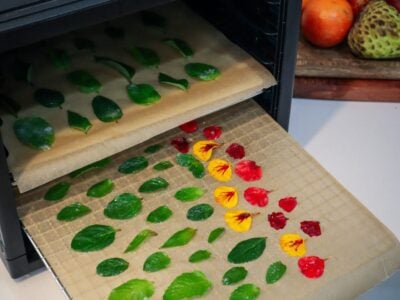
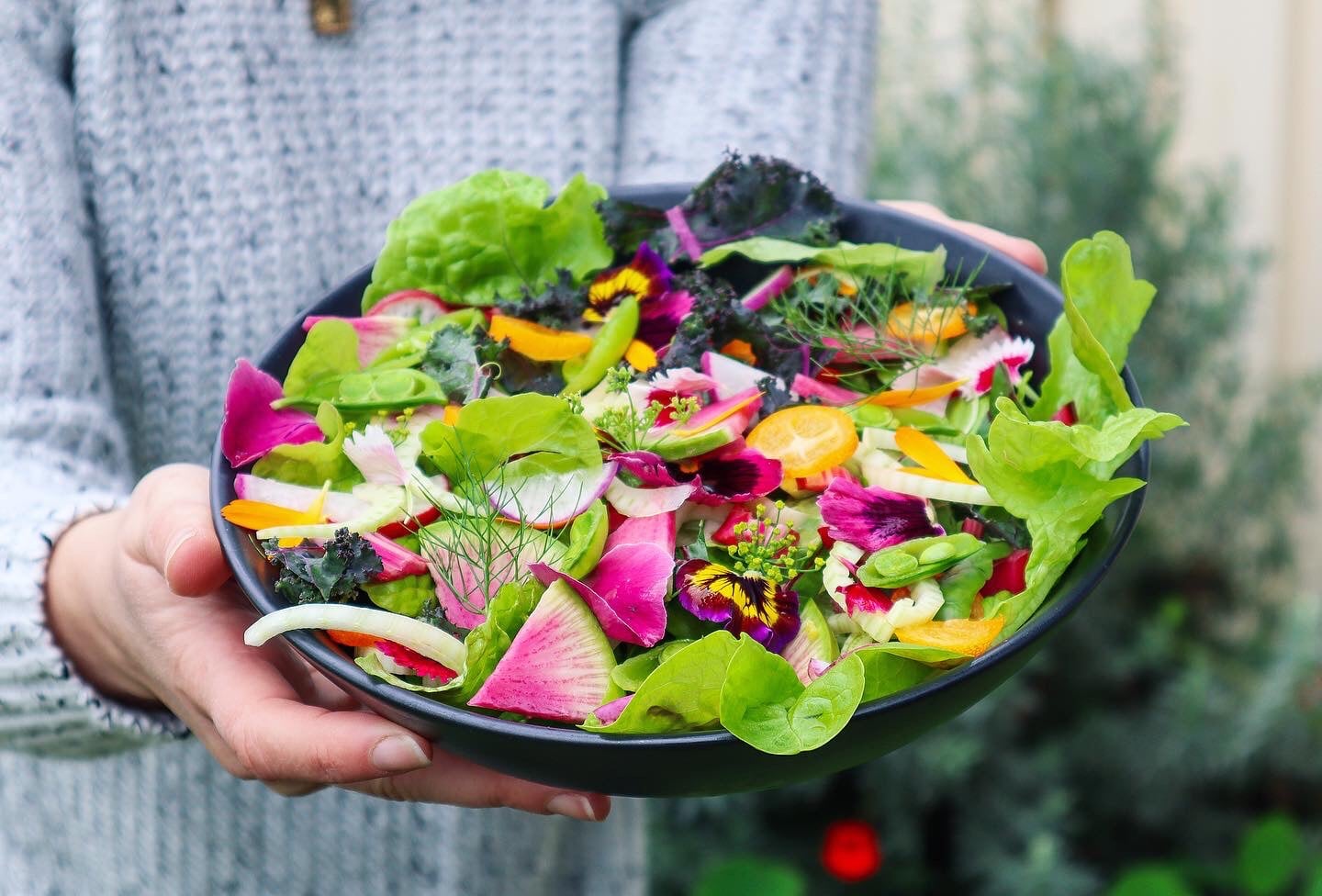
Garden toast is something I created one day when I was scraping together something for lunch and all I had was a crust and some cottage cheese in the fridge. I didn’t have any avocado, eggs or anything special to have with it. So I went out into the garden and found some inspiration! I picked two small tomatoes, herbs and edible flowers. It looked like a mini garden on toast and now I can’t stop making these beautiful, tasty creations!
Here are the creations I have made so far..
Original Garden Toast
My first addition with the last piece of bread I had left! I had fun making this and it definitely tasted delicious! Ingredients: Rye Multigrain toast, Cottage Cheese, Fresh tomato, Parsley, Rosemary, Rosemary flowers, Zinnia Petals and Basil leaves.
Fairy Garden Toast
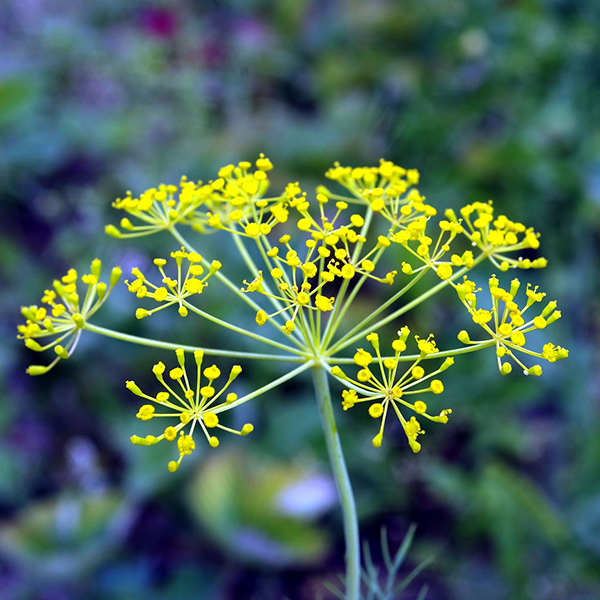
It’s amazing what a little bit of Beetroot juice can do! Natural colouring and plenty of beneficial nutrients with an array of micro herbs and greens. You may even be able to convince your kids to eat more greens with this Fairy Garden toast. Get them involved in the process by having a bowl each to go outside and collect herbs. Ingredients: White Multigrain Toast, Cottage Cheese mixed with beetroot juice or fresh grated Beetroot, Baby Nasturtium leaves, Parsley leaves, Basil leaves, Sweet Violet flowers, Rosemary Flowers, Baby Pink chard leaves, Pink Zinnia Flower petals and Dill Flowers.
Jungle Garden Toast
Packed full of herbs and flavour! Ingredients: Country Grain Toast, Basil Pesto, Orange Nasturtium petals, Tiger Eye Viola Petals, Strawberry Flowers, Parsley leaves, Rosemary Flowers, Pea tendrils, Burgundy Marigold Petals and Purple basil leaves.
Summer Garden Toast
Summer on toast! Homegrown tomatoes are so sweet and delicious and tomato on toast is one of my favourite ways to eat them! Ingredients: Rye Multigrain toast, Red, yellow, orange cherry tomatoes, Purslane, Red basil leaves, Strawberry Flower, Sweet Violet Flower, Dill flowers, Rosemary Flowers, chopped Purple Kale, baby Nasturtium leaves and Fresh Chilli.
Botanical Garden Toast
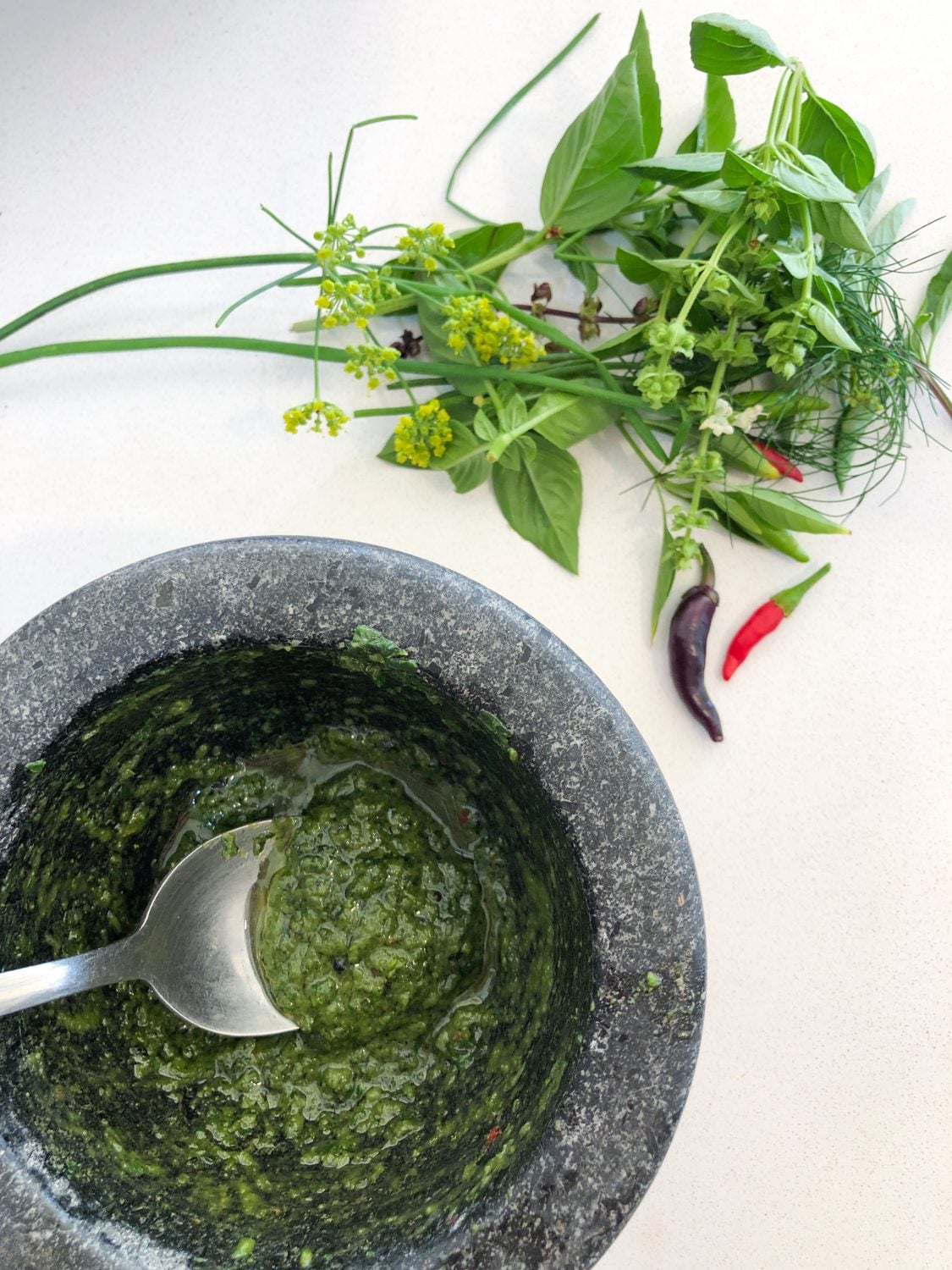
Pest on toast is so delicious! I made extra pesto and if you follow me on Instagram you would have seen that I ate this for breakfast for an entire week! It was also so good with a poached egg on top. Ingredients: Sourdough toast, Basil pesto, Cottage Cheese, Chopped walnuts, Fresh Chilli, Basil Leaves, Fennel Flowers, Pink and White Dianthus, Baby Pumpkin Tendrils, Parsley Leaves and Strawberry Flowers.
Unicorn Garden Toast
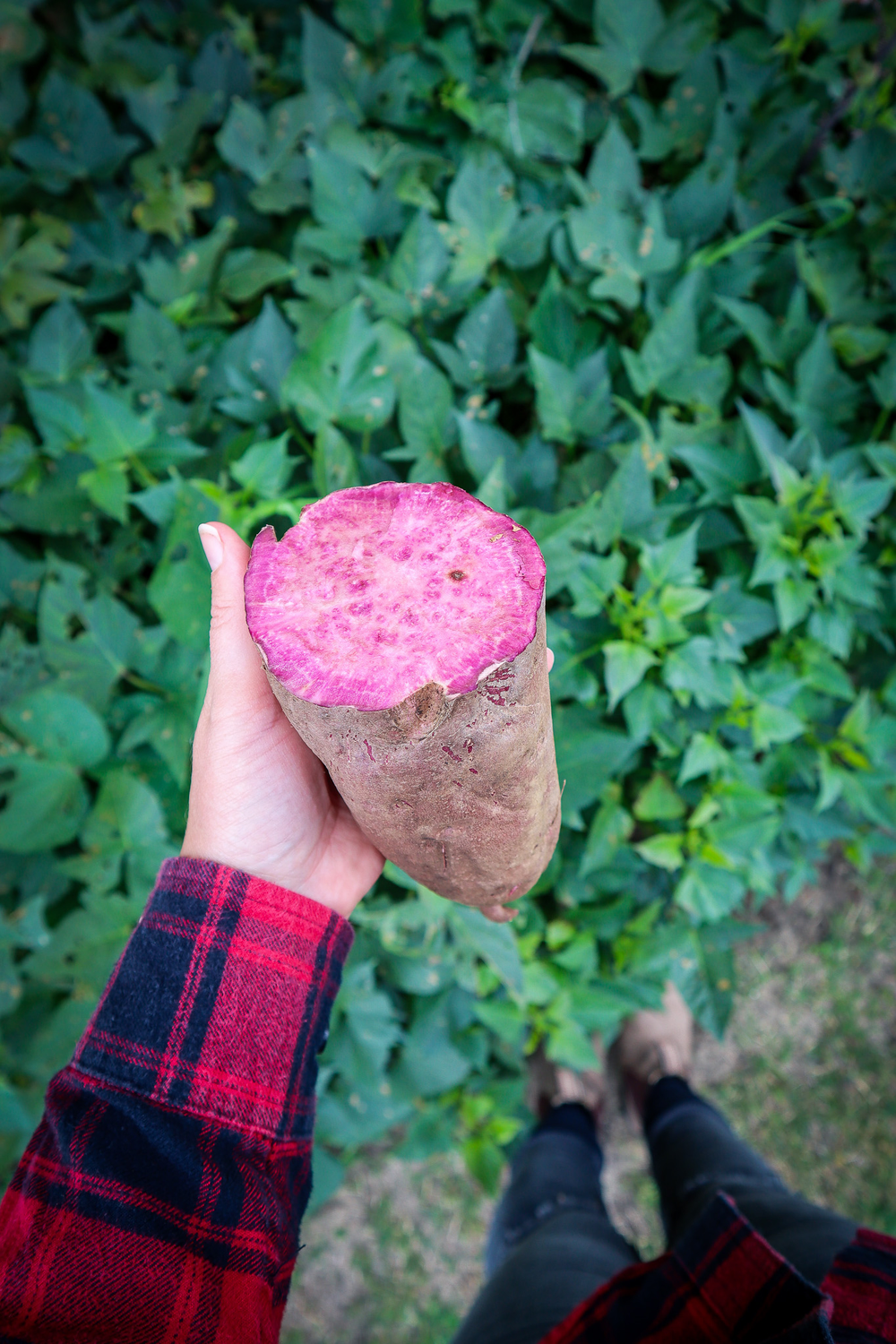
My latest creation and maybe my favourite yet! Purple sweet potato spread is a vibe! Ingredients: Sourdough Toast, Mashed Purple Sweet Potato and Cottage Cheese, Overnight Pickled Red Cabbage and Red Onion (1/2 cup water, 1/2 cup apple cider vinegar, a teaspoon of sugar heated to dissolve. Pour cooled liquid over Cabbage and Onion), Purple Kale, Grilled Baby Eggplant, Purple Pansy, Multicoloured Dianthus, Rosemary Flowers and Red Basil.
Get Inspired by your Garden
There is always something in my garden to make a toast topping and I love how easy and creative it is! Each piece is so unique and full of fresh garden nutrients! Having these ideas tried and tested means I know I can always whip up something even when my fridge is looking very lean.
Get creative and inspired by your own garden. There is something so satisfying about being able to walk outside and make a meal from your own fresh, homegrown veggies. This is a great meal idea for beginner gardeners who don’t have many established edibles. Just look out for baby leaves and edible flowers (make sure you research and clearly identify they are edible). Baby leaves and flowers can add subtle flavours and turn any dish into a work of art!
Be sure to tag me on Instagram or Facebook so I can see your creations!
There is no better time to start growing your own food than NOW. Creating your own food security and using your time to help create a greener world is win-win. I have always had the dream of growing my own food and living a more sustainable lifestyle and it is something that I have been continually building and working towards for years. I don’t want to be 100% self-sufficient because there are just some things I either won’t be able to grow or choose not to grow. But there are plenty of ways to supplement my homegrown food supply such as trading, swapping, and local farmers markets. I have put together (in no particular order) 18 simple ways you can start living a more self-sufficient lifestyle today.
1. Start a Herb Garden
No matter whether you have a big garden or live in a tiny apartment, growing herbs can be easy and takes up very little space. Grow in small pots, recycled containers, hanging planter,s or windowsill planters. If you like to use herbs it is a great first step towards self-sufficiency. And no, that does not mean buying those packed herb pots from the supermarket…. they are often grown hydroponically and then placed in the soil so they rarely survive long and don’t handle being planted out into real life. Get a packet of seeds and try growing your own 🙂
2. Start a Vegetable Patch
The best way to learn how to grow vegetables is to simply start trying! Start small with either a planter box or convert one small patch of your garden or even driveway into an edible vegetable patch. You can also start by simply integrating edibles into your established garden. Once you start growing some things you can start expanding bit by bit. Goodbye grass 🙂
3. Plant Fruit Trees
I love fruit trees because although they take a while to get going, once they do, they are abundant and don’t require as much care as vegetables. You can plant them in either a large pot or directly into the garden. I would recommend going to a local specialist fruit tree nursery so they can help you choose the best fruit tree for your location. Also, make sure you get something with fruit you actually enjoy! With the abundant produce you can then preserve, swap, and trade with others!
4. Grow Base Crops
I couldn’t think what else to call them but growing crops that will feed you for longer and create a good base to fill your pantry. Crops such as Pumpkins, Potatoes, Onions, Garlic, and Sweet potatoes will provide decent amounts of food that you can store and use throughout the year! A great base vegetable to feed a family.
5. Grow Soil
Composting is not only great for the fertility of your soil and the secret to AMAZING vegetables but also stops waste from going to landfill. There are a whole bunch of ways to do this depending on your living situation. You can make your own compost bin out of recycled wood, find a second-hand tumbler online or purchase one. You can also simply dig a hole in the garden and bury it (be careful of attracting pests though). There are also some new ways for people with no land to connect with others that do and give them your compost scraps. Either community gardens, local Facebook groups or now in Australia there is even an app! Sharewaste
6. Save Seeds
This is just as important as growing food and will be a huge step towards your self-sufficient journey. Saving seeds helps you maintain food security knowing that you have more healthy seeds to grow next year. Save seeds from your healthiest plants that thrive in your garden. Keep them in a dry dark place.
7. Grow Community
Get your friends involved! Take them over a basket of homegrown food or preserves. Once they see your delicious fresh food they may also get inspired! Help them out with seeds, and cuttings and surround yourself with like-minded people. Community gardens can be a great place to learn, get involved, and even seed/ produce swap. It can be an amazing network of knowledge, especially in relation to your local climate and growing conditions. There are also some great social media forums and groups that are great for finding answers to your questions and local knowledge.
8. Shop Local
Explore your local farmer’s markets! Grab a friend and go have a browse! They are usually on a Saturday or Sunday morning and I look forward to it every week. Although I love my local farmers market (Kalamunda) every few months I like to check out other farmers markets to mix things up and find new and interesting produce. Bulk food stores have been making a come back and I am sold! Lucky for me there is a fantastic Bulk Store ( Replenish Kalamunda) right by my local farmer’s markets. So I head there straight after I have picked up some fresh veggies. They may seem daunting at first but there are always plenty of signs explaining how to do it. I also love how each product clearly states where they have come from as I try to only choose Australian products.
9. Learn to Cook from Scratch
This is a big one! Learning to cook a wide range of meals from scratch using simple ingredients is key! I mean we can all make a butter chicken right…you just get the sauce and pour it in… Ditch the sauces from the supermarket and learn to make your own. I am constantly experimenting and expanding my knowledge so I can make a wide selection of meals from the produce I grow. Try to buy vegetables that are in season and fruits and vegetables that you are planning to grow. That way you can practice and become a pro at recipes for YOUR future harvests!
10. Grow Food From Scraps
Ok, this is one of my favourites! It is so quick and easy and a lot of fun! Plus you are getting the most out of your food. Buy one get multiple free!! Cut off the ends of your farmers market vegetables such as Spring Onion, Leek, Pineapple, Sweet Potato and regrow!
11. Forage and Trade
Keep an eye out on your walks and day trips for wild or excess food. So often there are olive trees, fruit, nuts or wild apple trees going to waste. Do your research and learn how to identify plants. That way you will know what you are looking at. It is also important to be careful if things have been sprayed by the council. I would be always cautious of things such as blackberries. You may even notice a neighbours tree loaded with fruit that is going to waste on the ground. Politely ask if you can have some in exchange for some preserves or baking you make with it. They will probably be happy for it to be used!
12. Repair and Upcycle
Get the most out of your things by fixing or updating them! Even if you don’t know how you may be able to pay someone a fraction of the cost to fix it rather than buying brand new. We often are so quick to throw out and buy new, we don’t even stop to consider if it can be fixed or repurposed. My hair straighteners and been fixed multiple times by electrician friends over the past 12 years and are still working amazingly! Recovering cushions, and couches, DIY, get creative, and even find a local seamstress if you don’t have access to a sewing machine.
13. Shop Second Hand
I try my best to not buy new and it is something I am continuing to work on. Most items you want can be found on Facebook market place, Gumtree (Trademe, Craigslist, etc). You can usually pick up a bargain and keep things in the loop rather than consuming more new things. You can even post in your local community groups and borrow or buy. Especially with things like appliances as many people often have them sitting in the cupboard collecting dust…Pasta maker, I’m talking about you 🙂
14. Backyard Chickens
Chickens make an excellent addition to sustainable living. They provide eggs, eat leftover scraps, produce manure for fertilising your garden, and can they also be incorporated into an integrated pest management system to help you keep your slugs and snails at bay. Many councils will allow backyard chickens in suburbia. Although I do not have chickens …yet (Pictured above is mums ‘Chick Inn’) my council allows x6 backyard chickens on properties 600sqm -2000sqm.
15. Back to Basics
Bread/milk/butter/pizza dough. The age-old skill of baking your own bread is a fantastic skill to have! How amazing to just whip up a fresh loaf of bread or make your own pizza bread without the preservatives or plastic packaging. Milk is super easy and you can make delicious plastic, preservative-free milk whenever you want! Whether that’s oat, rice or almond milk.
16. Learn to Preserve Harvests
I am not really at a point yet where I have an abundance of produce to preserve but I have planted a lot of fruit trees…so I am starting to learn different ways to preserve things so that when I am flooded with produce (yay!) I will be able to make the most of it! Get some produce from the farmer’s markets and give it a go! Jams, chutneys, sauces, pickles, nasturtium capers and all those delicious things. They also make great gifts and can be used to swap for other produce with your friends and family and community.
17. Make your Own
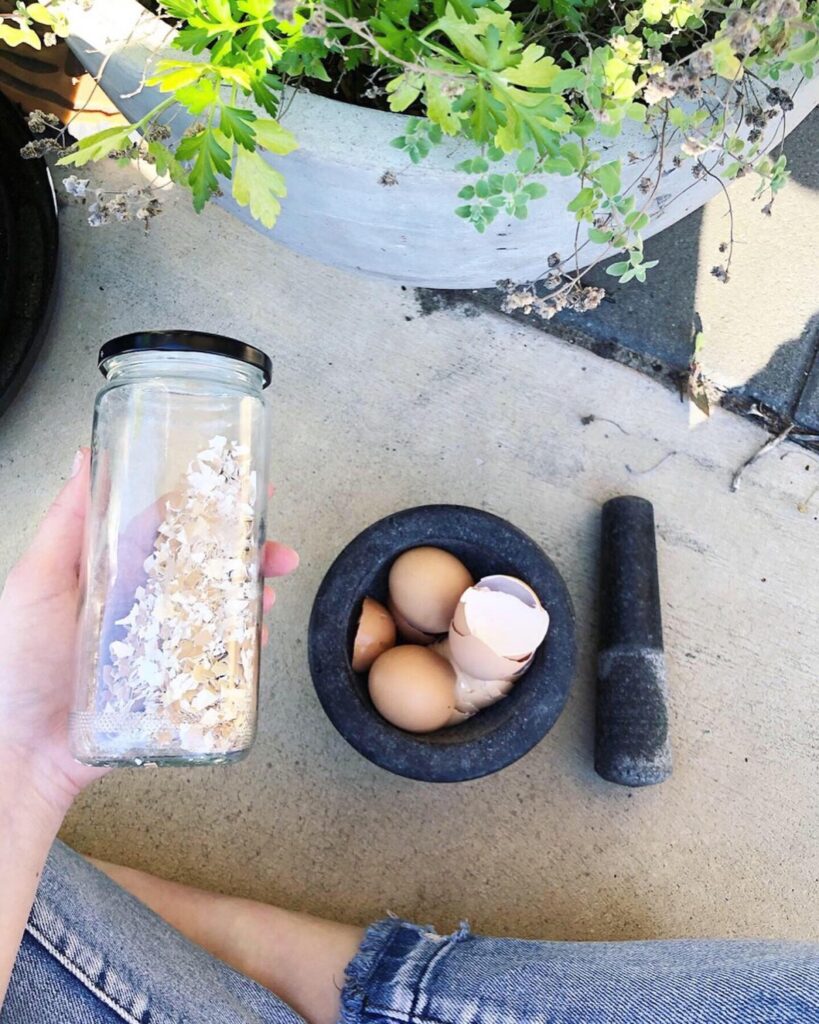
Ditch the toxic chemicals and pesticides and start making your own natural cleaning and garden products. You can get a few ingredients from your local bulk stores such as white vinegar and bicarb soda and make a huge range of cleaning products. Check out my Citrus cleaner here. I also used crushed eggshells to keep slugs and snails at bay. Natural pest management
18. Learn, Read, Practice
I can’t stress how important this is! Knowledge is power. Join your local library and get a book on jam making or search YouTube for “how to prune a lemon tree”. Educating yourself and giving things a go will get you a long way on your journey to living a more self-sufficient lifestyle. Take things one a time and really try and master it before moving on. It can be overwhelming if you try to do it all at once and may lead to failure and giving up.
Small and slow solutions!
Holly 🌱
MY GARDENING ESSENTIALS // Fertiliser spray gun: https://bit.ly/366nL1t Retractable Hose: https://bit.ly/2TSC0Bo More gardening tools: https://bit.ly/32IQmbD
DISCLAIMER: Links included in this description might be affiliate links. If you purchase a product or service with the links that I provide I may receive a small commission. There is no additional charge to you! Thank you for supporting my page so I can continue to provide you with free content!
When I first started gardening here I remember googling ” how to keep plants alive in a heatwave?” 😅 Welcome to Perth summer gardening! I have always struggled with how hot it gets here in Perth in summer. After 7 years here, the 40degree days don’t get any easier! We have a large amount of thermal mass at our house with concrete and paved areas so it can get so hot in my garden! One of the main reasons I decided to make pallet planters on wheels was to be able to grow more food during the hot summer months by being able to have them undercover on hot days. Watch how we made them here.
How to keep plants alive in a heatwave
If you are experiencing a heatwave or have days of hot weather ahead of you, here are a few tips I use to try and get my plants through!
🌱 WATER | Give a good deep water early in the morning. This will allow time for the moisture to reach the roots before it evaporates.
🌱 SHADE | If your plants are in containers move them undercover or to a shady area of your garden. Otherwise, try and rig up some temporary shade using shade cloth or even umbrellas to keep the direct sun off your plants during the hottest part of the day.
🌱 PROTECT THE SOIL | Ensure you have a good layer of mulch or ground cover over your entire garden. This will protect the soil from being exposed to direct sun and reduce the amount of water loss through evaporation.
🌱 BUILD SOIL | This is something that should be continually worked on by composting and adding more fibre and leaf matter to your soil. Sandy soils like we have here in Perth allow all the water to drain away and can become severely water-resistant. But by consistently mulching, composting and adding green matter, you will not only grow strong, healthy plants but also protect your plants from future dry spells. Healthy soil is key!
🌱 REPLENISH | As the sun goes down and the temperatures start to drop again, give your plants another well-earnt drink. This should help their leaves perk back up again.
🌱 SAVE SEEDS | If you notice a certain plant seems to survive better than others in hot weather, make sure you save the seeds at the end of the season. That way you can futureproof your garden by growing strong plants that you know will grow well in your exact climate.
My favourite watering tools are:
Retractable Hose with 7 spray nozzle and water flow adjuster: Control exactly how much flow you want to each plant with an easy retractable hose system. CLICK HERE for more info.
Deep root waterer and soil breaker: Helps get water directly to the roots without any runoff or loss of water from evaporation. CLICK HERE for more info.
Weeper hose works great for drip-feeding water and allowing the plants to absorb more. CLICK HERE for more info.
Happy Gardening!
Holly 🌱
MY GARDENING ESSENTIALS // Fertiliser spray gun: https://bit.ly/366nL1t Retractable Hose: https://bit.ly/2TSC0Bo More gardening tools: https://bit.ly/32IQmbD
DISCLAIMER: Links included in this description might be affiliate links. If you purchase a product or service with the links that I provide I may receive a small commission. There is no additional charge to you! Thank you for supporting my page so I can continue to provide you with free content!
I much prefer offering natural and sustainable solutions rather than a pointless list of negative things not to do. But this topic is something I am very passionate about and something new gardeners often get caught up in (including myself when I first started growing food many years ago). You will find my list of natural pest management remedies below 🙂
When you first start growing food you will get slugs and snails eating your new precious veggies and will want to INSTANTLY fix the situation. I see some newbie gardeners pour on huge amounts of snail bait to combat the hungry predators. This is POISON, not only will it kill the slugs and snails but is also deadly to cats and dogs. Now, if it can kill dogs, having it covering the soil and getting watered in and absorbed into the soil that your vegetable will feed on, especially those root vegetables, cannot be good for us.
If you’re reading this and thinking…I do this..you are not alone. It is something that has been a “norm” for way too long. But the first step you can take is safely throw out your poisonous slug bait. I would place it in something that animals can’t get into in case it crosses paths or they get into the bins. Even better, contact your local council to find the best way to safely dispose of it.
Watch my latest video
There are plenty of ways to naturally combat pests and have safe and nontoxic vegetables for your family.
Eggshells – Save your eggshells and dry in the oven on low. Then crush into small pieces and place in a jar. Sprinkle this around the base of your vegetables and the slugs and snails do not like the surface so will stay away. It also adds some beneficial calcium to your soil.
Plant extras – Plant a few extra plants in different areas of your garden so that if one gets attacked you still have plenty 🙂
Encourage beneficial insects – Plant diversity and flowers to create habitats and attract beneficial insects. You could even make an insect hotel using lots of different sized sticks and logs for them to live 🐞🐝
Manually remove – Go out and check your garden and remove the pests by hand. I often do this when I am on the phone, its a great way to multitask.
Beer Traps – Cheaper the better, there is no need to use up any fancy craft beer. Place little containers around your vegetable patch and this will capture the slugs and snails before they get to your precious veggies 🍺
Coffee grounds – Often your workplace or local cafe will be throwing these out anyway. Sprinkle around the base. Only add a small amount as it will change the PH of the soil ☕️
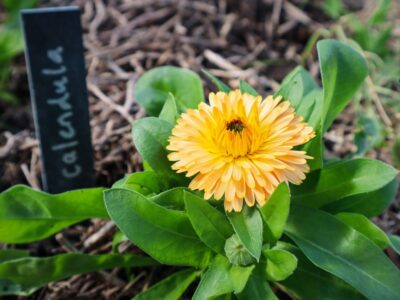
Companion Plants – Often very fragrant plants will repel pests. These are plants such as: Marigolds and Rosemary 🌼🌿
Soapy Water – this is great for aphids. All my dishwashing liquid is non-toxic and greywater friendly so I just mix up some diluted in water and paint it on the new growth that is affected by aphids. This is the last resort though as it may harm beneficial insects too. Try and isolate the coverage.
Chilli spray – Mix up some chilli powder in some water and spray on your affected plants. I have read crushed garlic as well but that is bad for dogs so I would avoid.
Healthy Soil – growing healthy soil by composting and mulching helps keep your plants strong and healthy 💪 this means that if they do get bugs they can survive and thrive after an infestation.
Sacrificial plants – Usually one plant will just get attacked and I just leave it. It usually means the bugs will only eat that plant and the rest will be fine! Sorry for that one plant but it’s feeding nature…🌿
Chickens and ducks are also a great way to integrate natural pest management into your garden. Win-win 🐛🦆
MY GARDENING ESSENTIALS // Fertiliser spray gun: https://bit.ly/366nL1t Retractable Hose: https://bit.ly/2TSC0Bo More gardening tools: https://bit.ly/32IQmbD
DISCLAIMER: Links included in this description might be affiliate links. If you purchase a product or service with the links that I provide I may receive a small commission. There is no additional charge to you! Thank you for supporting my page so I can continue to provide you with free content!
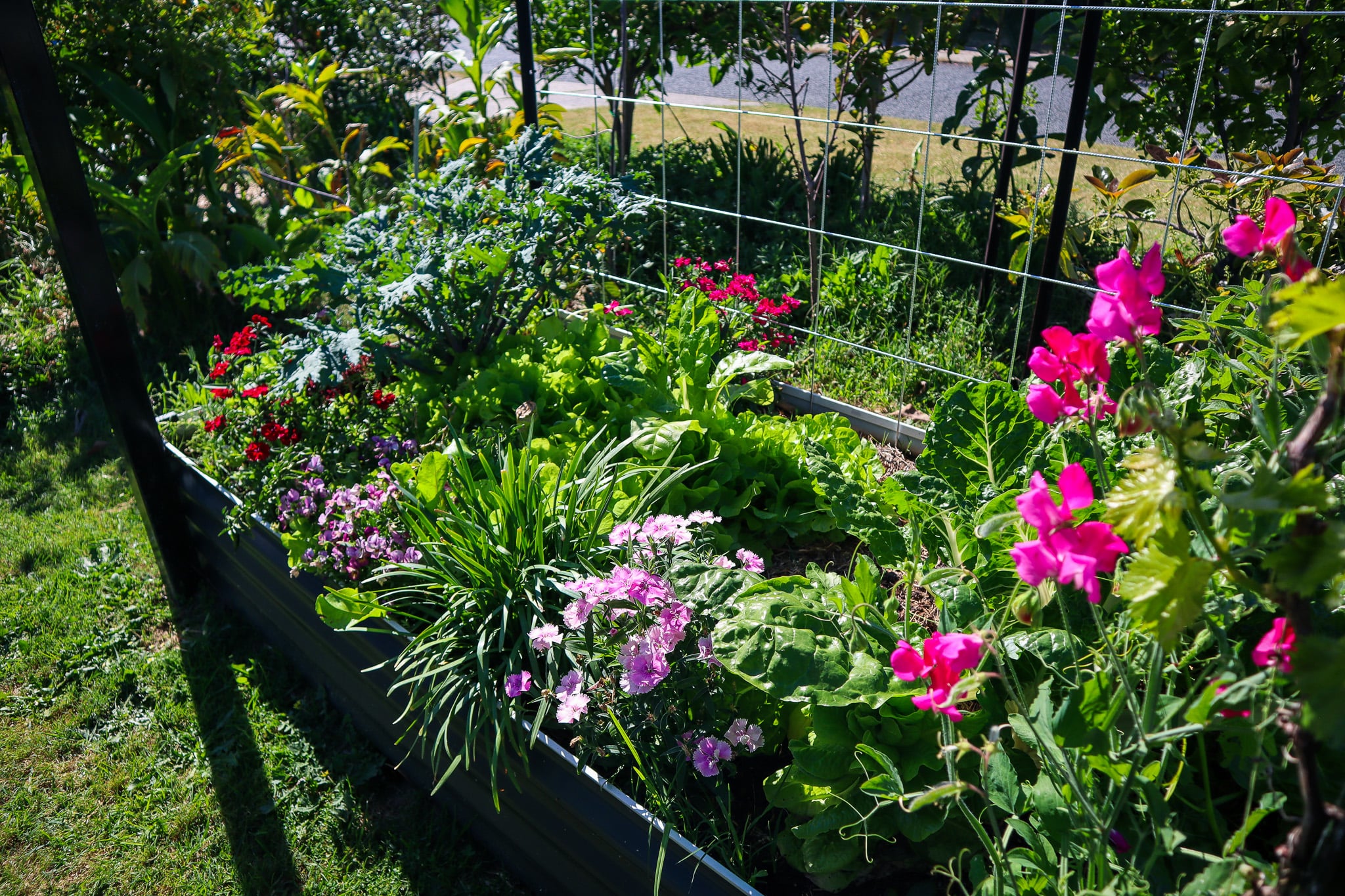
Growing vertically is one of the easiest ways to harvest more food from your garden without needing more space. I am constantly on a mission to make the most of the space I have, and these DIY garden trellises have been such an easy way to double my veggie patch space.
With such a few simple supplies, I have been able to add vertical growing spaces to my raised beds, container gardens and even my mini driveway food forest (to grow kiwiberries).
Whether you’re growing climbing beans, cucumbers, peas, luffa, sweet potatoes, gourds or even tomatoes, a sturdy DIY garden trellis can support healthy growth, improve airflow and make harvesting much easier.
It’s such a quick and easy project that can help you maximise the amount of food you can grow, keep plants disease-free and off the ground. If you’re looking for an easy DIY garden trellis for raised beds that is affordable and durable, this simple setup might become your new favourite garden upgrade. I hope you love it as much as I do!
Why Every Garden Space Needs a Trellis
Many gardeners focus on improving soil, composting, and watering systems, but vertical growing is often overlooked and definitely underrated. A trellis or frame transforms a raised bed or garden into a three-dimensional growing space, allowing you to harvest more food from the same area. I have many different arbours and trellises throughout my gardens to give shade, structure and more room to grow! These are some of the reasons I am always looking to add more…
Grow More Food in Less Space
Instead of sprawling across the ground, climbing vegetables grow upward. This leaves plenty of room to grow both vining plants AND lower shrubs, companion plants, herbs, and leafy greens underneath. More food in the same space! Perfect for small spaces or just to condense gardens to save water and time.
Improve Airflow Around Plants
Plants growing vertically receive better airflow, which can reduce fungal diseases and improve overall plant health. Wet leaves on things like pumpkins, watermelons, tomatoes or even peas can result in powdery mildew and other unwanted problems.
Easier Harvesting
There’s no need to hunt through tangled vines. You can see your fruit and veggies and monitor when they are ready (to get to them before other critters do), making harvesting quicker and more enjoyable.
Less Pest Pressure & Damage
Vegetables growing off the ground stay cleaner and are less likely to develop rot or pest damage. Vertical gardening does help slow down pests like slugs, snails and slaters.
Garden Aesthetics
I want my gardens to not only be productive but also look good! Trellis or arbors help frame a garden space and also allow you to create privacy and direct shade or light.
ready to grow beans and peaspurple podded peas on the move
The DIY Garden Trellis I Use
Over the years, I’ve experimented with bamboo structures, string trellises, and various DIY supports. While many work well initially, they often require maintenance or struggle under the weight of productive crops. Usually just lasting one season…I wanted something that lasted longer and i could grow a wide range of plants on.
The result is a sturdy raised bed trellis that can support heavy crops while withstanding wind, weather, and multiple growing seasons. Because the setup is so simple, I can install a new trellis whenever I need one without spending hours building structures or buying expensive materials.
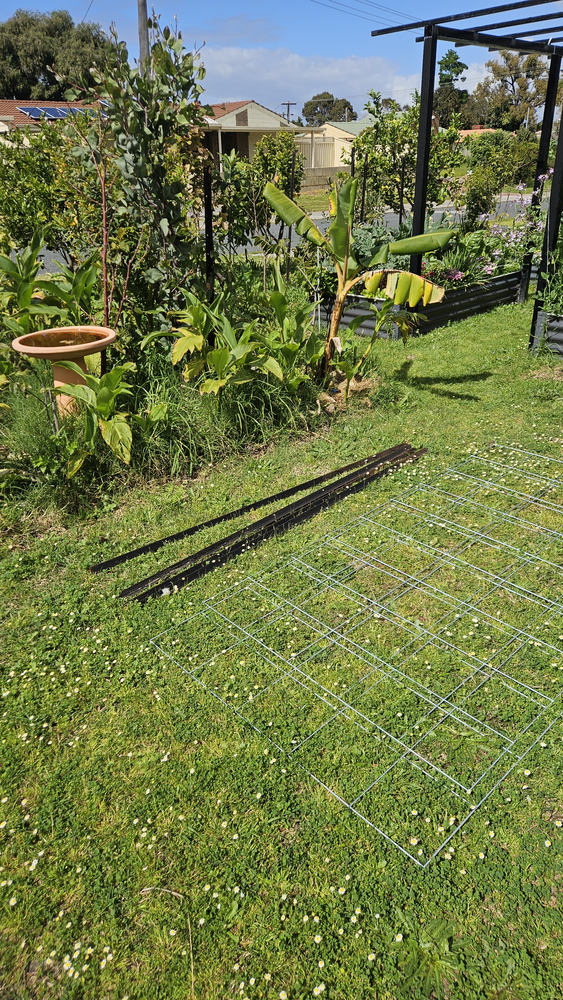
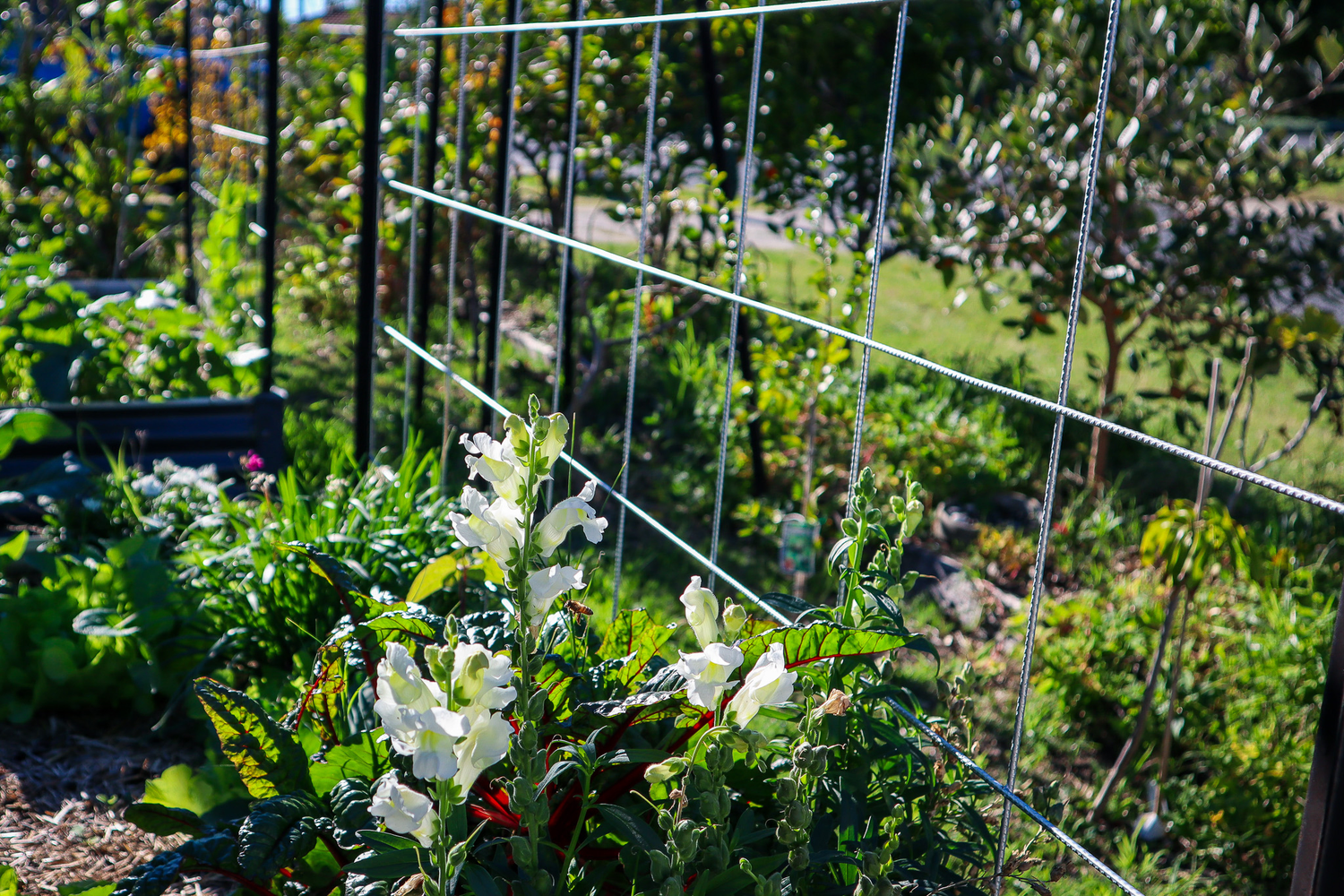
Second-hand star pickets and metal wire grids ready to be quickly installed and make two DIY garden trellises for my raised beds in the front yard.
What Size Wire or Grids Should be Used for a Trellis?
I like to use a large grid wire or mesh compared to a smaller (chicken mesh) style because it is much easier to remove plants. At the end of the season, or if you want to replace or prune plants, the smaller mesh trellis can be very time-consuming to remove the plants from! Not something you think about until that time comes…so hopefully this helps future you!
What Side of the Garden Should I Install a Trellis – Does it Matter?
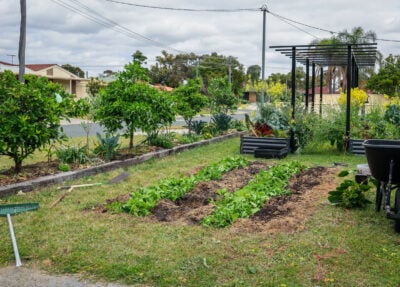
It is important to figure out the right placement for your trelilis! As your plants attach and climb up vertically, they can shade out other parts of your garden beds. Here in the southern hemisphere (Perth, Australia), I have mine set up on the two southern garden beds and have the trellis on the south side of those beds. That way the sun tracks around the front (north) and no light is blocked from my veggie patch.
I only have the trellis in the two southern garden beds, and it is on the southern side of those beds to allow light to reach all four of my raised beds.
DIY Trellis Supplies Needed
Grow Garden Panel
I have used both the Grip & Grow panel and rolls of large mesh fencing wire to form the climbing surface. The grid openings provide plenty of attachment points for tendrils, vines, and climbing stems. The rigid design makes it suitable for supporting heavier crops like bottle gourds, cucumbers, and climbing beans. Keep an eye out for second-hand supplies to make this even more affordable!
Two Star Pickets
Star pickets provide strong vertical support and anchor the trellis securely into the ground. They are easy to bang into many soil types and are usually easy to find second-hand. The height you choose will depend on your crops, but taller pickets allow climbing vegetables to reach their full potential.
Wire Ties
Simple wire ties secure the panel to the pickets. They are inexpensive, durable, and easy to replace if needed. I initially used zip ties as that is all I had, but wire ties are a much better option.
Optional Extras
Gloves
Mallet or hammer
Pliers
Zip ties
How to Build This DIY Garden Trellis
One of the best things about this project is how quickly it comes together.
Step 1: Install the Star Pickets
Drive one star picket into the ground at each end of your raised garden bed but make sure they are the same distance as your panel or mesh. Make sure they are firmly secured and positioned vertically.
Step 2: Position the Panel
Stand the panel between the two pickets. Adjust the height so the panel sits comfortably above the bed while remaining secure.
Step 3: Secure with Wire Ties
Attach the panel to each picket using wire ties. These go through the holes in the star pickets and the corners of the mesh. Use several ties along the height of the panel to prevent movement during strong winds or when supporting heavy crops.
Step 4: Plant Your Climbing Vegetables
Once installed, the trellis is ready for planting immediately. Seeds or seedlings can be planted directly at the base of the trellis. The entire setup process typically takes less than ten minutes!
Why I Love This DIY Raised Bed Trellis
There are plenty of trellis ideas, and over the last 10+ years, I have tested out quite a few, but this system keeps winning me over for a few simple reasons.
It’s Fast – Installation takes minutes rather than hours.
It’s Affordable – There are no expensive materials or specialised tools required. Many supplies can even be found second-hand! The panels I used cost $36 each, but i also used free fencing mesh for other ones.
It’s Strong – The trellis can support vigorous crops and heavy harvests.
It’s Freestanding – It can be placed anywhere and stand on its own (after being secured into the ground)!
It’s Reusable – At the end of the season, the structure remains ready for the next crop. No need to remove it.
It Works Year-Round – The same trellis supports summer vegetables and winter vegetables without modification.
What I Grow on My Trellis During Summer
Growing vertically in summer can also help offer shade or wind protection to your garden.
Cucumbers
Cucumbers naturally climb and produce cleaner fruit when grown vertically. Growing cucumbers on a trellis improves airflow and makes harvesting easier. I like to grow lebense and the heat-tolerant varieties (Poonah Kheera and Armanian cucumbers)
Climbing Beans
Both climbing beans and runner beans thrive on this support system. Regular harvesting encourages continuous production throughout the season.
Snake Beans
Snake beans are one of my favourite hot-climate crops. Their long vines quickly cover the trellis and produce heavily through warm weather.
Bottle Gourd
Bottle gourds can become surprisingly heavy, but these panels handle the weight with ease.
Luffa
Growing luffa vertically produces straighter fruits and makes harvesting much simpler.
What I Grow on My Trellis During Winter
A good trellis isn’t just for summer. In my garden, it remains productive throughout winter.
Peas
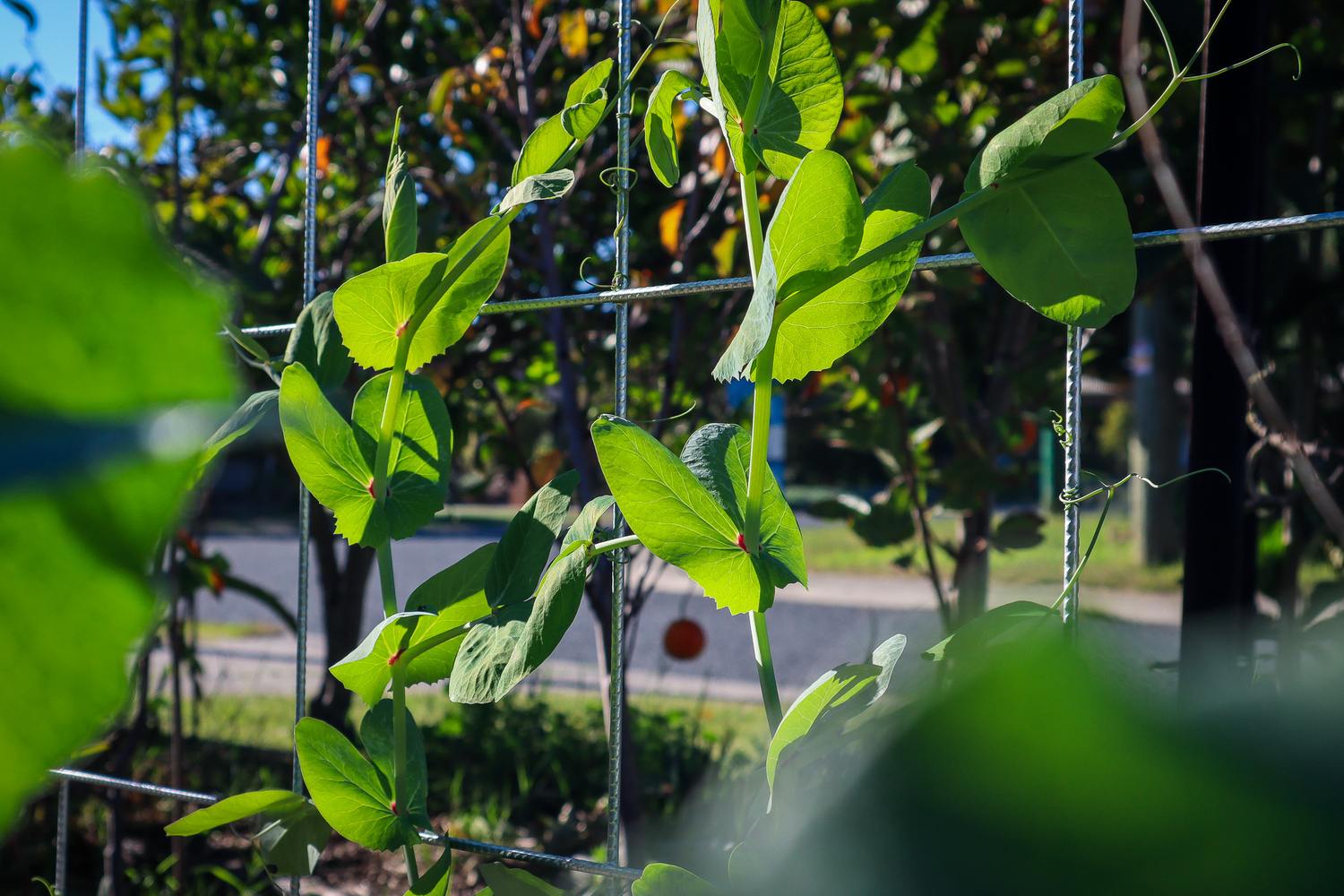
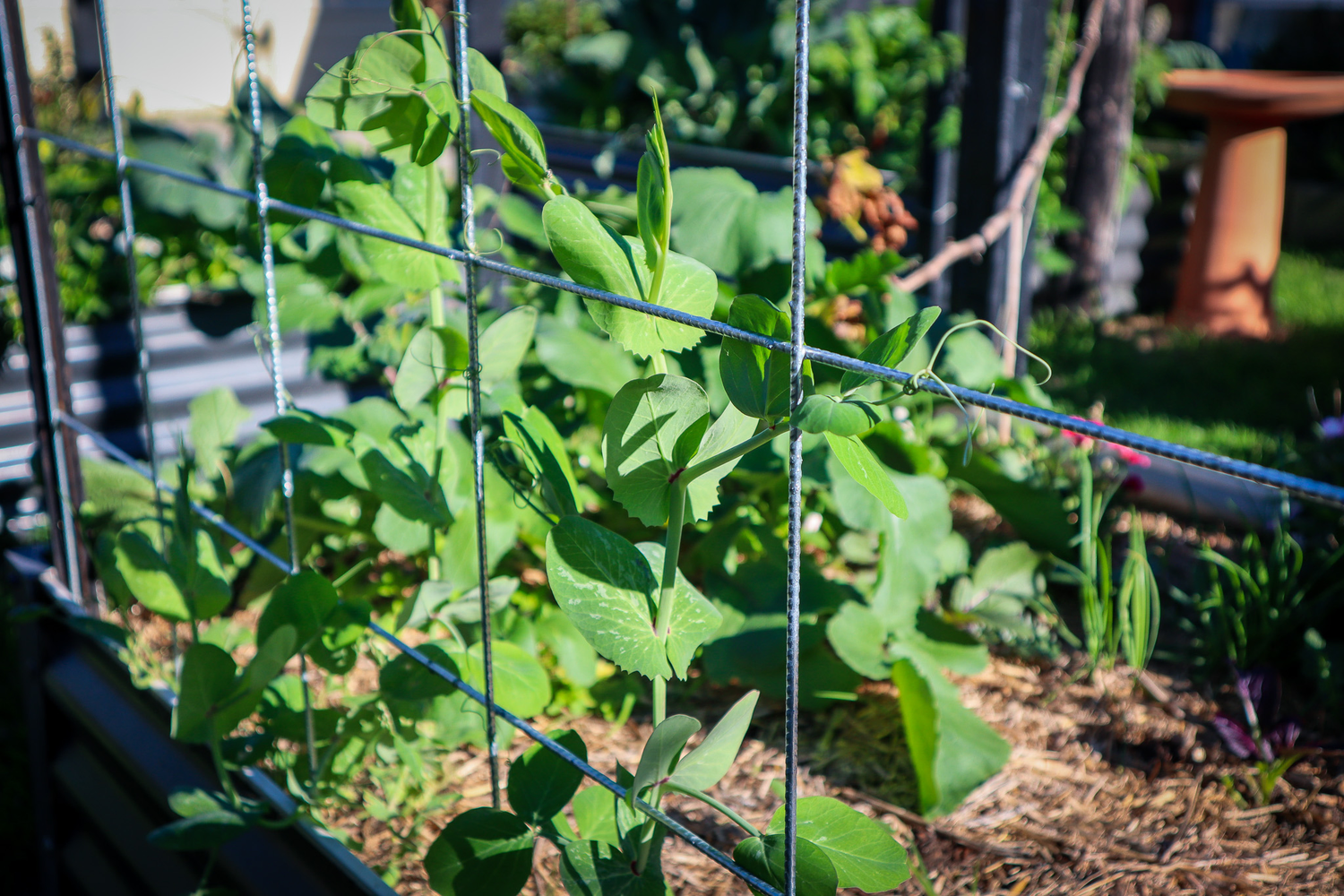
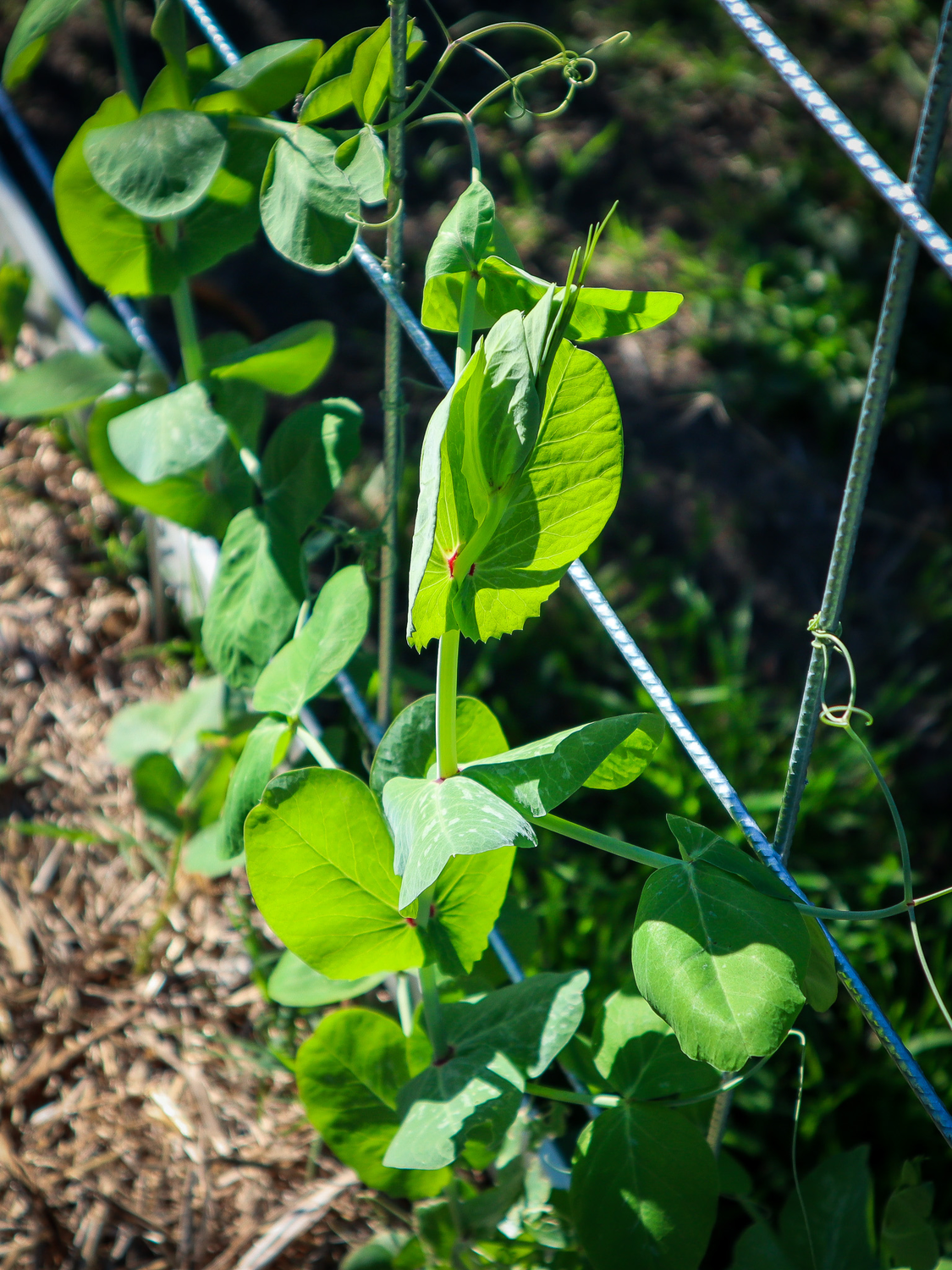
Peas are one of the easiest climbing vegetables for cool-season gardens. They make the best garden snacks!! I grow different peas each winter. including snow peas, purple podded peas and sugar snap peas. Peas also help fix nitrogen and improve your soil!
Climbing Nasturtiums
Nasturtiums attract pollinators while providing edible flowers and leaves. They can get a little wild so growing them vertically can help contain there spread.
Sweet Peas
While ornamental rather than edible, sweet peas can add colour and fragrance to winter beds. They also offer flowers for the bees during a lean time.
Tips for Growing Vegetables on a Trellis
To get the best results from a garden trellis, plant your seeds or seedlings close to the base so they can easily reach the support as they grow. As young vines begin to develop, gently guide them onto the trellis while the stems are still flexible. I check my plants daily to add coffee grinds to stop the pests naturally and also direct the plants to the trellis. Regular harvesting will help encourage ongoing production as the plant’s main goal is to provide seeds for a new generation….if we harvest them before they get to that stage, the plant will produce more = more food for us! Healthy soil is also key to strong growth, so add plenty of compost and organic matter before planting to feed the soil and support vigorous, productive vines.
Common Trellis Mistakes to Avoid
Installing the Trellis Too Late
Trust me… it’s much easier to train young plants than try to wrangle mature vines without snapping them.
Using Weak Supports
Many DIY trellises struggle once crops become productive. Build with strength in mind from the start.
Ignoring Crop Weight
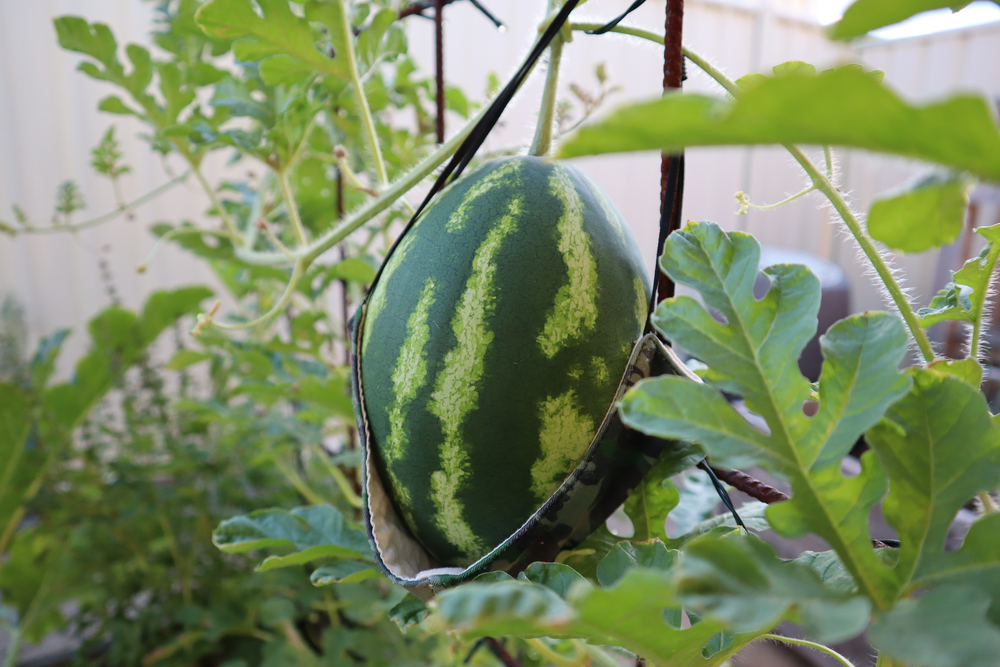
Large gourds, pumpkins, and vigorous vines require strong support systems. Sometimes i also offer extra support by making the large fruits little hammocks.
Forgetting to Secure Against Wind
Strong winds can place significant pressure on climbing crops and their supports.
Supporting my vertical growing watermelon with a mini hammock
Frequently Asked Questions
What is the best DIY garden trellis for raised beds?
A sturdy panel supported by star pickets is one of the simplest and most durable options. It installs quickly, lasts for years, and supports a wide range of climbing vegetables.
What vegetables grow best on a trellis?
Cucumbers, peas, snow peas, climbing beans, snake beans, bottle gourds, luffa, and Malabar spinach all perform well on a trellis.
Can I add a trellis to an existing raised bed?
Yes. This DIY garden trellis can be installed alongside existing raised beds without modifying the bed itself.
How tall should a vegetable trellis be?
Most climbing vegetables benefit from a trellis between 1.5 and 2 metres tall, although vigorous crops may grow even higher. The higher you go the more vulnerable the trellis will be to winds, so the support pickets will need to be longer and go deeper into the ground.
Is vertical gardening worth it?
Absolutely. Vertical gardening allows you to grow more food in less space, improves airflow, simplifies harvesting, and helps maximise the productivity of small gardens.
Vertical Gardening in Urban Spaces
Of all the upgrades I’ve made to my raised garden beds, this DIY garden trellis has delivered some of the biggest returns for the least effort. Which i am all about! With nothing more than a metal panel, two star pickets, and a few wire ties, you can create a strong support system that helps climbing vegetables thrive year-round.
Whether you’re growing cucumbers in summer, peas in winter, or experimenting with productive crops like bottle gourds and luffa, vertical gardening is one of the simplest ways to maximise your harvest.
If you’re looking for an easy DIY garden trellis for raised beds, this quick and affordable setup is a practical solution that can help you grow more food in less space.
Winter is usually when worm farms get forgotten….Everything in the garden slows down, food scraps sit untouched, and the balance can easily be thrown off. Mould, bad bacteria and bugs can take over a once-healthy worm farm and leave you starting from scratch come spring…I have been there – done that, and it slows down momentum right when your garden is ready to explode into growth again.
If you’re using a worm farm as part of your natural or organic garden system,winter is actually a really important time! I rely on mine as a steady source of free natural fertiliser for my edible gardens…so I don’t really get the option to ignore them for a few months without it affecting my soil and plant health later on.
I have two worm farms set up in my edible gardens here in Perth, Western Australia (Zone 10b). Which has a Mediterranean-style climate: hot, dry summers and mild, wet winters. Even here, where winters are relatively short and mild (compared to many parts of the world), I still find it cold in winter, and so do the worms!
With a few simple tweaks, your worm farm will not only survive winter but… it can stay healthy, active, and ready to bounce back stronger than ever in spring to feed your abundant gardens!
Understanding What Happens to Worm Farms in Winter
Worms (red wigglers or tiger worms) are most active in warm, stable conditions, generally between 15°C and 25°C. When temperatures drop below this range in winter, their metabolism naturally slows down. They eat less, move less, and spend more time deeper in the bedding where conditions are more stable.
The worms are not dying or becoming unhealthy…they are just conserving energy until conditions warm up again. What this means is: less breakdown = less worm castings and liquid fertiliser being produced for your garden.
In my own garden here in Perth, not only with my worm farms but also with my own habits 😅 After a HOT and STRESSFUL summer, it can be easy to forget about parts of the garden. Even though we don’t experience freezing conditions…( not sure how I would cope with that!), the cooler nights and wet soil are enough to reduce worm activity quite noticeably.
Winter Conditions Your Worm Farm Needs
Even during winter, worm farms still rely on a few key environmental conditions to stay healthy. The most important factor is temperature stability. Worms do best when their environment stays above 10–12°C, even if they are not at peak activity.
Moisture is equally important, but this is where many winter worm farms run into problems. In climates like Perth, winter rain can quickly push a worm farm from “moist and healthy” into “waterlogged and oxygen-starved.” When this happens, worms are forced to move away from the surface or, in extreme cases, attempt to escape altogether (and we don’t want that!).
Airflow also plays a role. Bedding that becomes compacted or too wet can restrict oxygen, which slows decomposition even further. A healthy winter worm farm should feel damp like a wrung-out sponge, with a soft, aerated structure rather than a dense, soggy, stinky mass.
Why Worm Farms Slow Down in Winter
Lower temperatures reduce microbial activity in the bedding, which in turn slows down the breakdown of food scraps. At the same time, worms themselves become less active and eat less frequently. This combination creates the impression that nothing is happening, when in reality the system is simply operating at a slower pace.
Overfeeding is often what makes this problem worse. When more food is added than the worms can process, it begins to accumulate and break down anaerobically, which can lead to stinky smells, mould, bad bugs and unhealthy conditions. This is one of the biggest reasons worm farms stop producing efficiently in winter…not because the worms fail, but because the system becomes overloaded and stops converting scraps into usable fertiliser.
In most cases, winter issues in worm farms are not caused by the worms themselves, but by us being a little too generous and continuing summer feeding habits through winter.
How to Feed Worms in Winter
One of the most important adjustments in winter is reducing how much you feed your worm farm. Because the worms are less active, they simply cannot process the same volume of food as they do in warmer months.
Instead of frequent feeding, it is better to offer small amounts of food and wait until most of it has been broken down before adding more. This helps maintain balance in the system and prevents excess material from accumulating.
Soft vegetable scraps (like peels), coffee grounds in moderation, and crushed eggshells are all suitable winter foods. Heavier or slower-decomposing items should be reduced during this period, especially in wetter climates where breakdown is already slowed by cooler temperatures. Think small, thin, and not to water logged or heavy (don’t throw in large chunks).
What to do with Excess Scraps in Winter (so you don’t overload your worm farm)
When worms slow down, food doesn’t disappear quickly. It builds up. Then it starts to break down in the wrong way, creating mould, bad smells, and oxygen loss in the bedding. So instead of forcing everything into the worm farm, I treat winter as a split system.
If the worm farm is:
slow
already full
or still working through the last feed
I stop adding more, and I divert the excess straight into my compost bins instead.
Worm Farm vs Compost in Winter
In winter, the compost handles the bulk of scraps, so it is important to add enough brown material to match. You don’t want the extra scraps to off-balance your compost systems either. Add at least double the amount of brown to green material. A bucket of dried leaves always comes in handy for this!
How to Keep Your Worm Farm Warm and Stable
Keeping a worm farm warm in winter can be done with a few simple tweaks.
Place your worm farm in a sheltered position such as a covered patio, verandah, or protected corner of the garden. This helps reduce exposure to cold winds and heavy rain, which are two of the biggest winter stress factors.
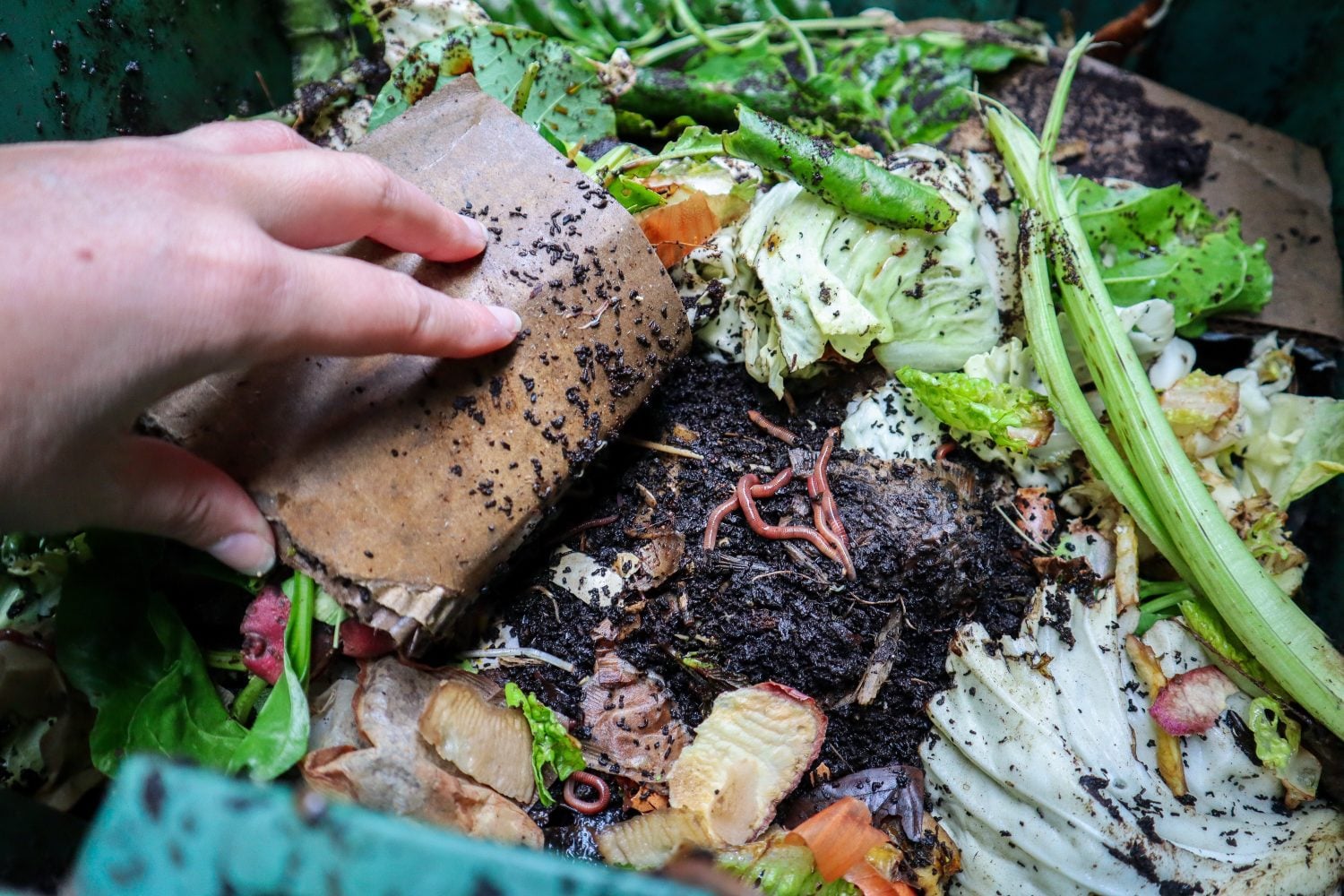
Add natural insulation over the bedding using materials like cardboard, shredded paper, or dry leaves. These help retain heat, buffer temperature fluctuations, and still allow airflow so the system can breathe.
In wetter climates, focus just as much on managing rain as temperature. Make sure the system has proper drainage and is not becoming waterlogged, as excess moisture can reduce oxygen levels and lead to anaerobic conditions.
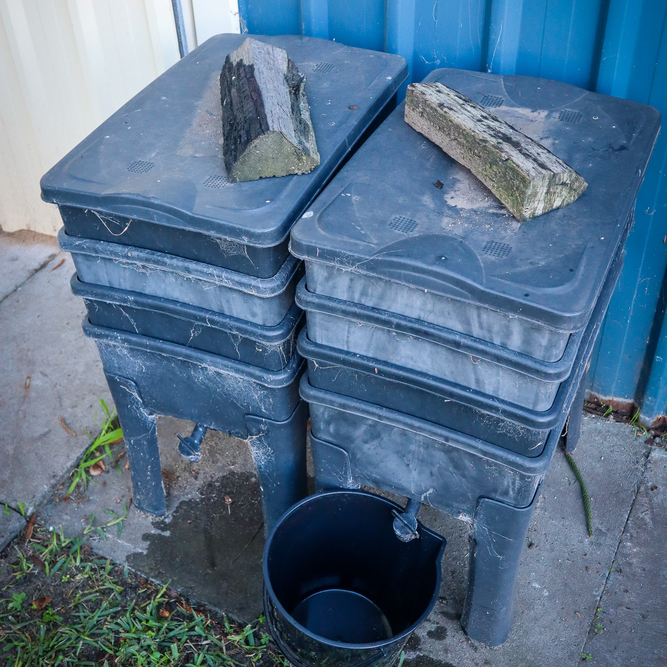
Empty the bottom tray of excess water regularly (weekly or fortnightly). This prevents the system from becoming too wet and helps maintain healthy oxygen flow through the bedding.
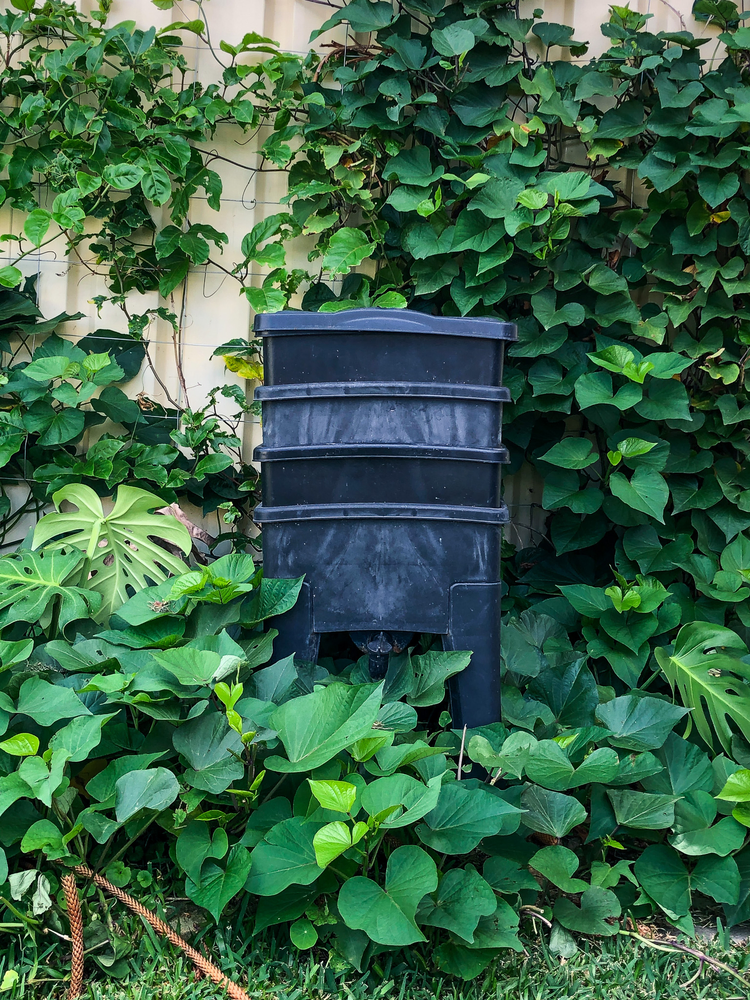
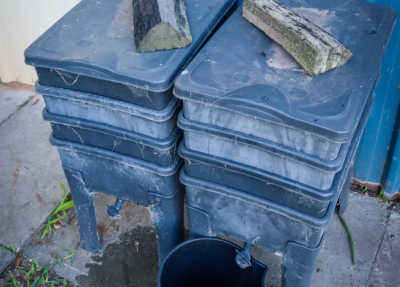
Secure the lid. I add blocks of wood on top of my worm bin lids to stop them from blowing off in wild weather. Make sure the ventilation holes are not covered.
What to Do With Worm Farm Liquid (Worm Tea)
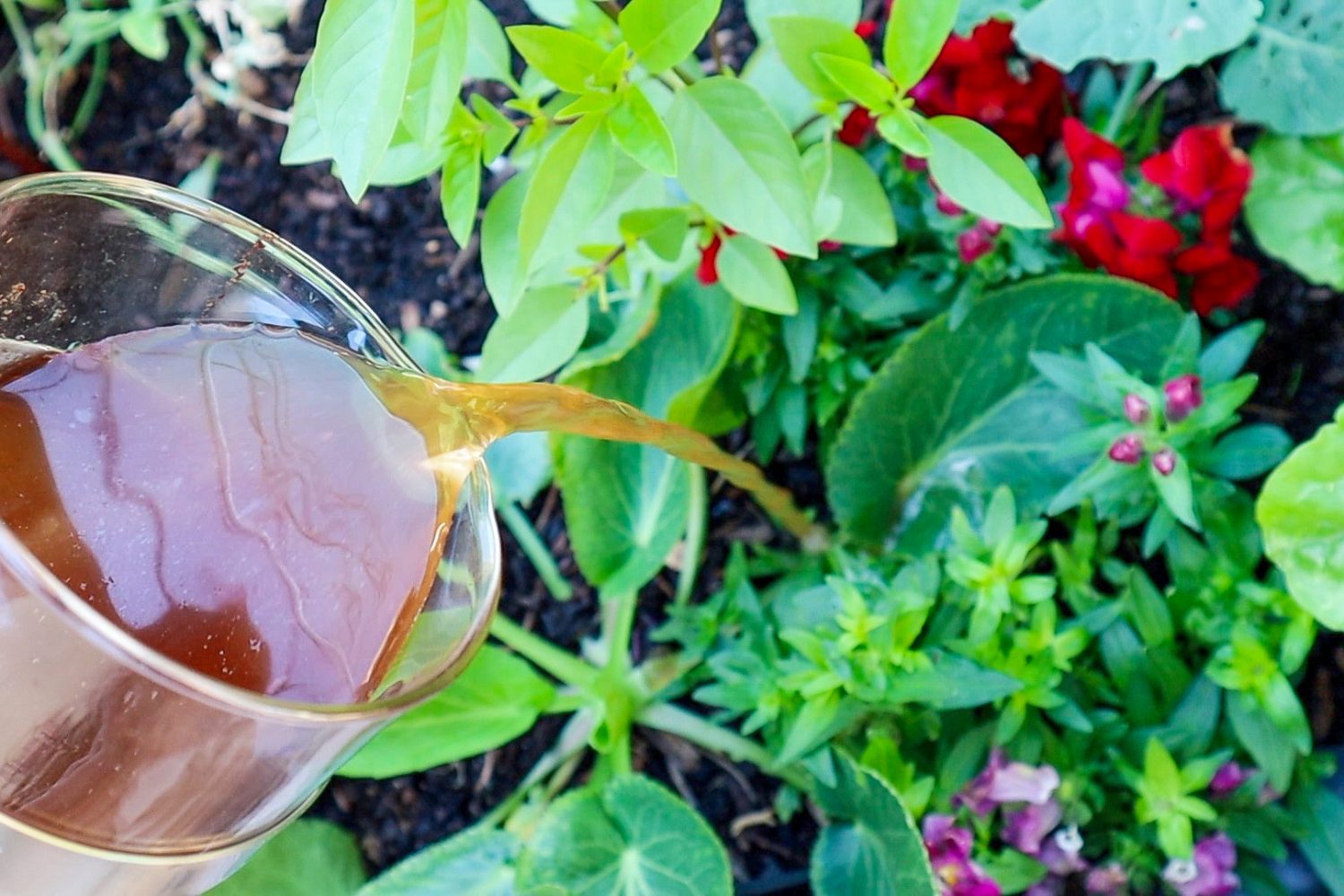
The liquid that collects in the bottom tray of a worm farm is often called “worm tea” or leachate. IIt can be amazing for natural garden fertilizers, but….
You want the liquid to smell earthy and sweet (not stinky and garbage-scented). It can be diluted and used as a liquid fertiliser. A good general ratio is about 1 part worm liquid to 10 parts water.
However, if the liquid smells sour, rotten, or anaerobic, it is better to avoid using it on edible plants (especially leafy greens you are going to harvest soon). This usually indicates that the worm farm has become too wet or oxygen-deprived. In this case, it’s safer to pour it onto non-edible areas such as ornamental garden beds, compost piles, or mulch zones where it can break down further. I usually add it to the base of fruit trees (watered down).
Either way, regularly emptying the tray is important. Allowing liquid to build up can create overly wet conditions in the worm farm. This can reduce oxygen levels and can slow or stress the worms.
What To Watch Out For In Winter
Excess moisture is often the biggest winter problem in worm farms, even more than cold temperatures. When bedding becomes too wet, oxygen levels drop and beneficial microbial activity slows down. Signs of this include a sour or stinky smell, worms trying to move away from the bedding, or the texture becoming slimy, mouldy and overly dense. When this happens, fertiliser production almost completely stalls until balance is restored. Restore balance by adding dry, carbon-rich materials such as shredded cardboard. This helps absorb excess moisture and improve structure. Gently loosening the bedding can also help reintroduce airflow and prevent compaction, keeping the system healthier and more stable.
Too much water in the bottom tray. I keep a bucket underneath mine and empty the water regularly. Especially if they has been recent rains.
Slugs and snails – check your worm farm every week or so to see how the materials are breaking down and remove any slugs and snails (check underneath the lid too).
Worm Farm Setup Tips for Winter
Not all worm farm systems behave the same in winter. Some handle cold and rain much better than others, so it’s worth adjusting based on what you’re using.
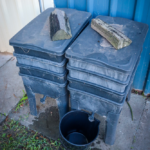
Stacked bin systems (like multi-tray worm farms) These tend to hold heat better because of their depth and insulation. This is the style that I use in my gardens. They’re generally stable in winter, but the bottom trays can become too wet in heavy rain, so drainage needs to be checked regularly.
DIY worm farms (containers, tubs, or crates) These are more exposed to temperature swings. In winter, they can cool down quickly and slow worm activity more noticeably. Adding insulation like cardboard, straw, or hessian around the sides makes a big difference.
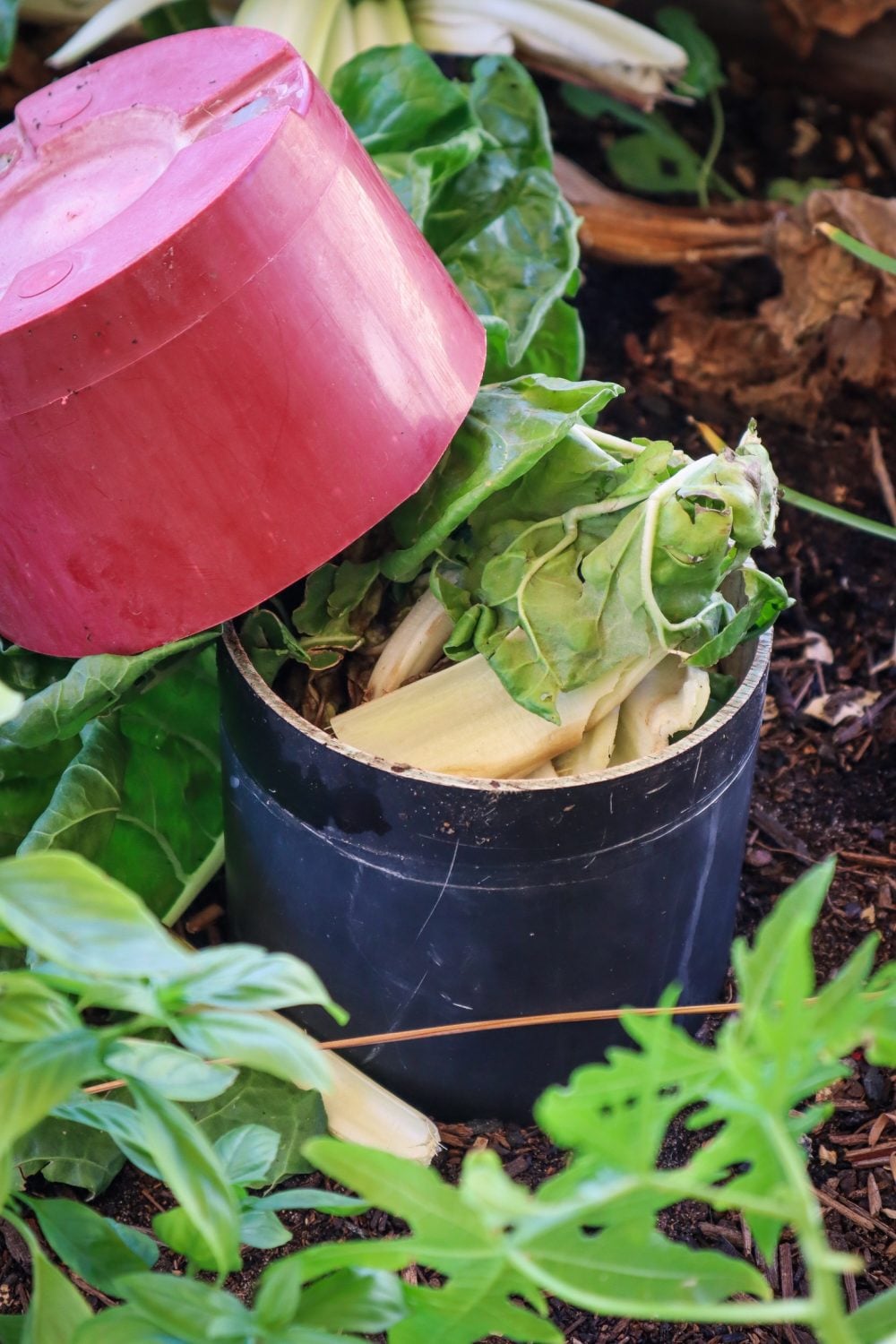
Worm towers (in-ground systems) These usually perform best in winter because the surrounding soil acts as natural insulation. They stay more temperature-stable, but you still need to monitor moisture, especially in sandy soils where water drains quickly.
No matter the system, winter success comes down to the same two things: keeping moisture stable and protecting worms from sudden temperature swings.
How Worm Farms Recover in Spring
As temperatures begin to rise again, worm activity increases rapidly. This is when all the patience and restraint from winter pays off. The worms become more active, feeding increases naturally, and decomposition speeds up significantly.
In a Zone 10b / warm climate like Perth, this transition can happen quite quickly. One warm week can speed up the whole system. By maintaining balance through winter, you allow your worm farm to enter spring in a strong, stable condition, ready to ramp up production.
Watch how quickly the scraps are being used and slowly add more.
Troubleshooting FAQ:
Is it worth having a worm farm?
Yes! Absolutely, especially if you’re trying to grow food naturally and sustainably. I love how effective a small worm farm can be for creating organic fertilisers with very little effort on your behalf!
A worm farm is one of the easiest ways to quickly turn kitchen scraps into free fertiliser for your garden. You’re converting it into worm castings to help improve sandy soils by adding fibre and liquid fertiliser that directly feed your soil and plants.
In my garden, the worm farm is a crucial part of my organic fertiliser system. It reduces waste, improves soil health, and gives me a steady supply of nutrients for my fruit trees and vegetable beds.
Can I stop feeding my worm farm completely in winter?
Yes, temporarily pausing feeding is completely fine if conditions are cold or slow. Worms can survive for extended periods on the existing bedding and organic matter already in the system. In fact, overfeeding during winter is one of the most common causes of imbalance.
If you do pause feeding, make sure:
bedding stays moist (not wet)
there is enough carbon material (like shredded cardboard)
the system is protected from heavy rain and cold winds
Once temperatures rise again, you can slowly restart feeding.
How can you tell if worms are happy?
Happy worms are quite easy to spot once you know what to look for.
They should:
be active when you lift the bedding
move away from light quickly
be spread throughout the bedding, not all clumped together
have soft, moist bedding that smells earthy (not sour)
be eating food scraps gradually rather than leaving them to rot
A healthy worm farm should smell like rich soil. If something is off, the signs usually show up fast. Bad smells, worms trying to escape, or food sitting untouched for too long usually mean the balance of moisture, food, or airflow needs adjusting. In winter especially, “happy” often looks like slower activity..not dead silence. Worms naturally slow down when temperatures drop, so less movement doesn’t always mean a problem.
Do worms reproduce in winter?
Yes, worms do still reproduce in winter, but at a much slower rate…
They continue laying cocoons (worm eggs), and those cocoons can still develop, but everything slows down as temperatures drop. Instead of speedy reproduction like in summer, winter becomes more of a “maintenance and slow growth” period for the population.
In warmer months, worms are very active and can multiply quickly! But in winter, especially when temperatures drop below about 15°C, reproduction slows significantly. Below 10–12°C, it can almost pause until conditions improve again. Even though it looks like nothing is happening, cocoons are often still developing in the bedding.
Should you harvest worm castings in winter?
Yes, you can, but only if they’re ready…Worm castings are ready to harvest when most of the food scraps have broken down and the bedding looks dark and soil-like. It should smell earthy, like rich forest soil, with no sour or rotting smell.
In winter, this process usually slows down, so castings often take longer to fully mature compared to summer. If the worm farm is full, it’s better to stop adding fresh scraps to that section and give the worms a new layer or second worm bin to move into. Add a few cms of bedding and scraps to encourage them down. This keeps the system balanced and avoids disturbing the casting layer while it’s still developing.
If you’re unsure, it’s completely fine to leave them longer. The worms will continue to break them down and improve the quality over time. I usually wait until early spring to harvest, when I’m preparing garden beds for new planting. That’s when the castings are at their most useful anyway!
The Key to Year-Round Natural Fertiliser
Caring for a worm farm in winter is about trying to match the pace of the worms and help balance the winter elements. Try to keep things active to maintain your free natural fertiliser system year-round. With a few simple tweaks and regular checks, your worms stay healthy, your system stays balanced, and your garden continues to receive the slow but steady supply of nutrients, even in the colder months.
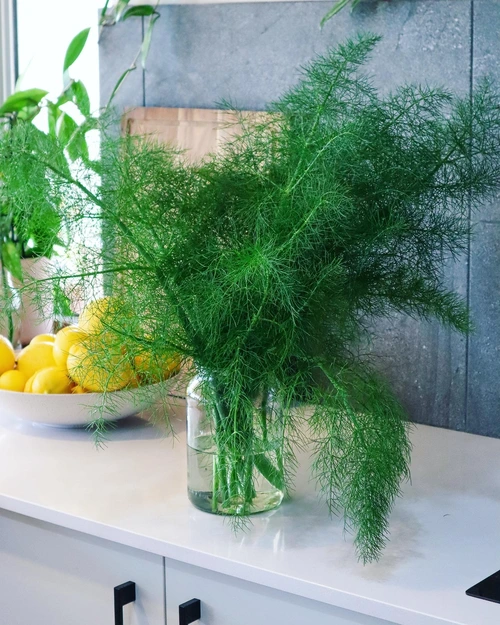
If you’ve ever grown fennel, you’ll know it’s a plant that just keeps on giving! But what do you do with all the Fennel Fronds/ Leaves?
When you buy Fennel, the fronds are usually cut off (like most food at the shops 50% or more of the plant is wasted!) so it’s not an ingredient we are used to using unless…you are growing your own… and lets be honest growing your own food can sometimes be challenging, so when harvest time arrives, I like to make the most of every part. From the bulb and fronds to the flowers and seeds…There are so many delicious ways to use fennel fronds in the kitchen and garden.
Utilising the whole plant is something I’m really passionate about. Below are my favourite zero-waste ideas, plus a few simple recipes to help you turn every harvest into something useful.
Can You Eat Fennel Fronds?What Do They Taste Like?
Yes! Fennel fronds (or leaves) are completely edible and one of the most underrated parts of the plant. These soft, delicate leaves have a mild aniseed or liquorice flavour similar to the fennel bulb but much lighter and fresher. Strangely enough…I don’t even like liquorice, but I do like fennel fronds…Think of them as somewhere between fennel, dill, and parsley. Fennel fronds can be used fresh, dried, frozen, blended into sauces, infused into oils, or sprinkled over finished dishes just like any other herb.
If you’ve been throwing them into the compost, you’re missing out on one of the most versatile ingredients in the garden. Fennel fronds are incredibly versatile in the kitchen, and once you start using them, you’ll realise just how many ways they can be added to everyday meals…I pretty much find a way to add them to everything!
Here are my favourite ways to use fennel fronds in the kitchen and garden:
1. Make Fennel Frond Pesto
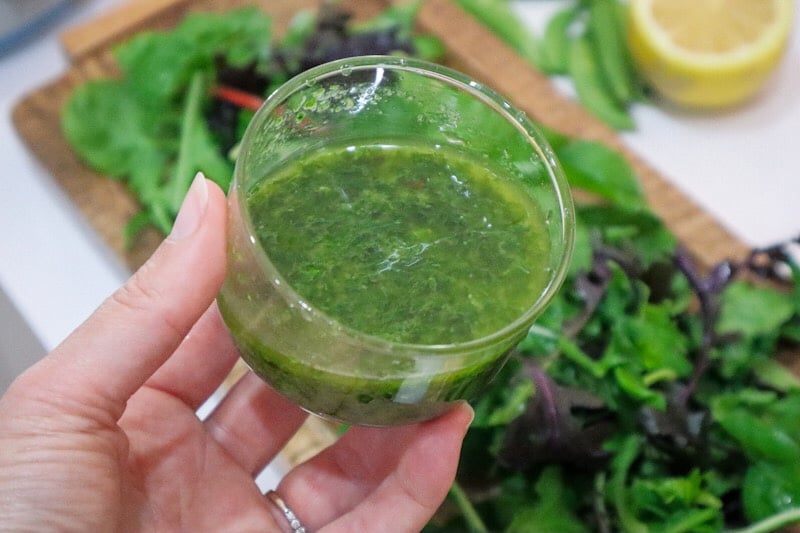
Fennel fronds make a delicious base for pesto. Their subtle aniseed flavour adds a delicious note, and they pair beautifully with nuts, garlic, and lemon. Swap it in anywhere you’d normally use pesto, on pasta, toast, roasted veg, or even as a dressing base. Fennel fronds have a delicious fennel flavour, and their delicate fern-like fronds lend well to so many recipes! They are so underrated as greens and are deliciously fragrant and packed with flavour.
Capture the aroma of fennel fronds in a simple herb salt. It’s an easy way to add flavour to roasted vegetables, seafood, or even to sprinkle over fresh tomatoes.
Fennel fronds are perfect finely chopped into leafy salads, potato salad, grain bowls, or sprinkled over coleslaw. They’re especially delicious with lemon, dill, cucumber, or citrus fruits.
Try this combo: Fennel fronds + rocket + orange + walnuts + olive oil = spring salad magic. Or add fennel bulbs to your roast veggies and finish with the fresh fronds for a hearty but fresh roast veggie salad.
4. Blend Into Dips and Sauces
One of my favourite ways to use fennel fronds is in homemade dips and sauces. I simply cannot have a meal without a good sauce!
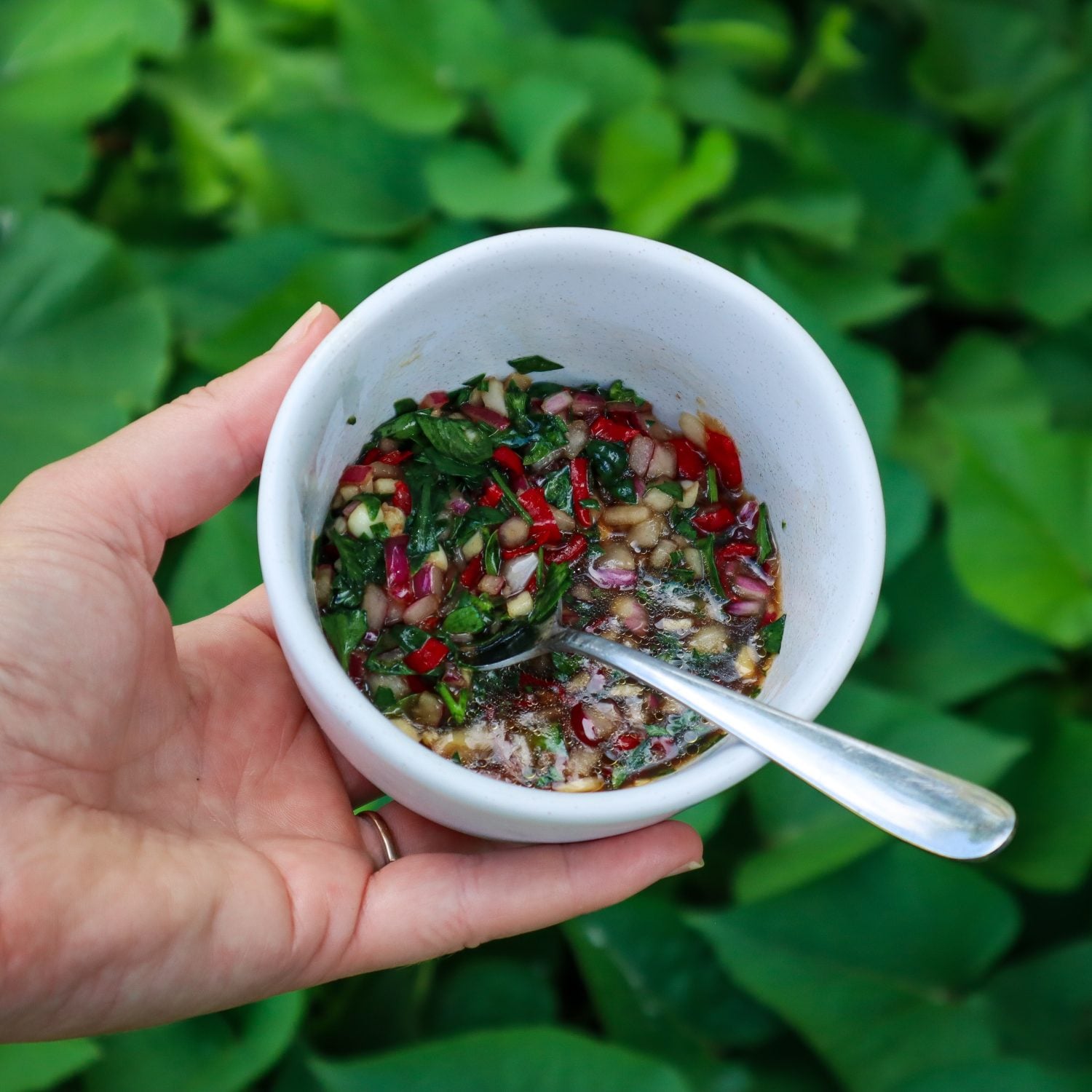
A handful of chopped fronds can instantly brighten up almost any sauce.
5. Infuse Olive Oil or Vinegar
Steep fennel fronds in olive oil or white wine vinegar for 1–2 weeks to create a lightly infused flavour enhancer. Perfect drizzled over roasted veggies or used in salad dressings.
6. Stir Into Pasta, Risotto and Grain Bowls
Treat fennel fronds like a fresh herb and sprinkle them over finished dishes. They’re particularly good stirred through creamy pasta, risotto, quinoa bowls, or roasted vegetable dishes. The bright green colour and feathery texture make any meal feel a little more special! And even if you don’t have many ingredients from the garden, adding your own homegrown fresh herbs is always a good feeling.
7. Use as a Garnish
Don’t underestimate the visual power of fennel fronds! Their soft, feathery texture adds a professional finish to soups, dips, grilled fish, or even cocktails. Both the fennel fronds and flowers look great on cakes.
8. Add to Veggie Stocks or Broths
Treat fennel fronds like bay leaves, toss them into stocks or slow-cooked meals for subtle flavour. Finely slice or leave whole and remove after cooking. They’re excellent in fish stock, vegetable broth, or tomato-based sauces.
9.Dry or Freeze for Later
If you’re harvesting lots of fennel, preserve the fronds for later. Or make your own dried mixed herbs! So easy and much more flavour than store-bought.
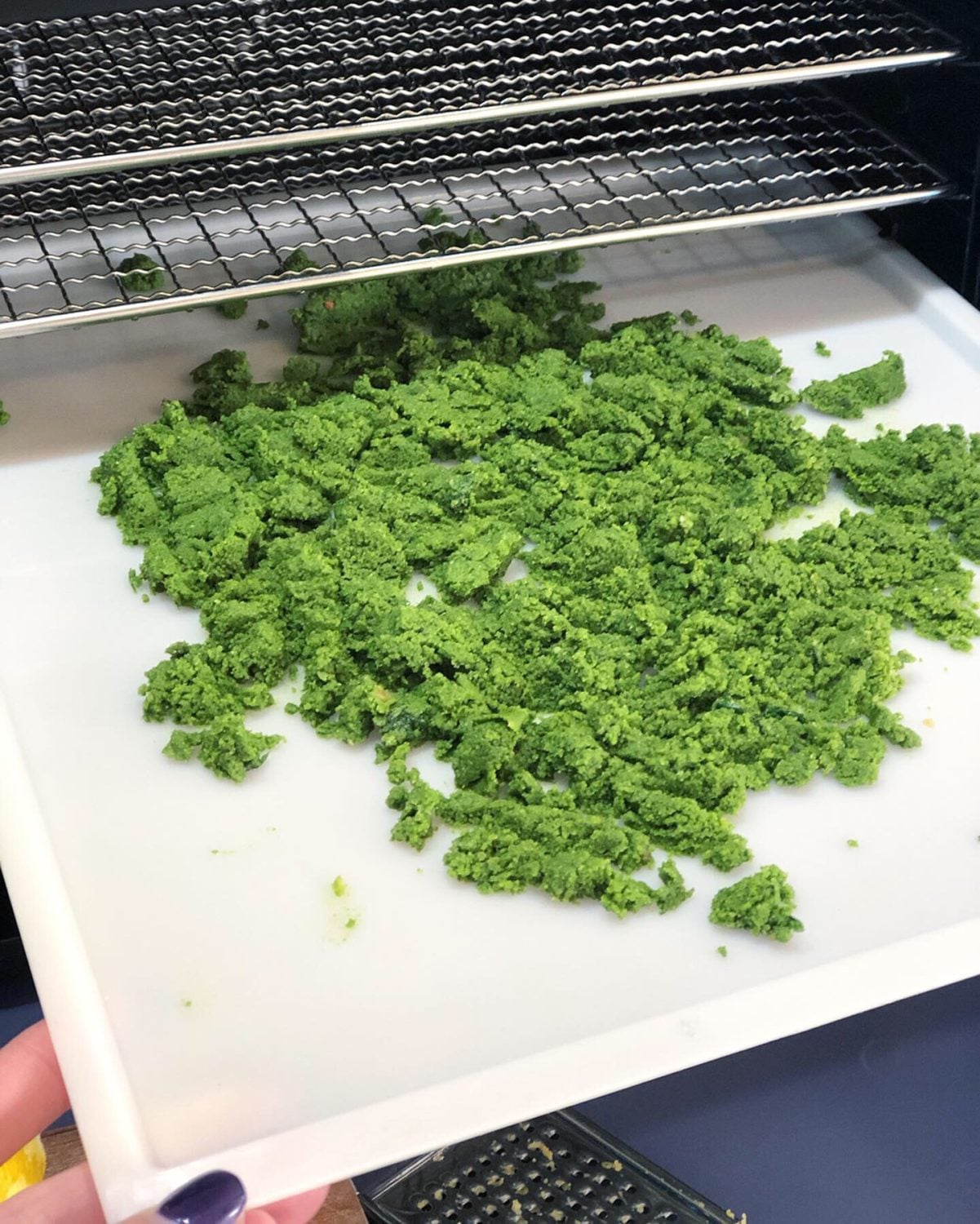
To dry: Hang in a dark, airy space or use a dehydrator.
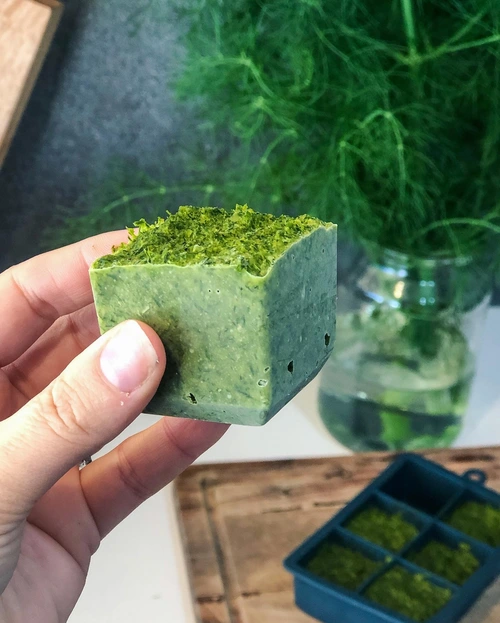
To freeze: Chop and store in ice cube trays with olive oil or butter.
Perfect for winter soups and sauces.
10. Make Compound Butter
Finely chop fennel fronds and mix them through softened butter with garlic and lemon zest. Roll into a log and refrigerate. This fennel butter is delicious melted over steamed vegetables, fish, baked potatoes, or fresh sourdough bread! Add a few edible flowers to make it extra special!
11. Use Fennel Fronds in the Garden as Natural Fertiliser
Not every fennel frond has to end up on your plate…
Used as a nutrient-rich green material in compost systems
This is one of the reasons I love growing my own food: very little of the plant needs to go to waste!
12. Make a Nourishing Green Soup
One of my favourite ways to use a large handful of fennel fronds is in a simple green soup. Their fresh flavour pairs beautifully with leafy greens, peas, zucchini, potatoes, and herbs. Blend fennel fronds into the soup at the end of cooking to preserve their bright colour and delicate flavour.
It’s a fantastic way to use up a bumper harvest while sneaking extra garden greens onto your plate.
If you’re looking for more ways to eat your garden harvest, fennel fronds can be blended into green smoothies. Their mild flavour works surprisingly well with fruits such as apple, pear, pineapple, and citrus, while adding an extra boost of leafy greens.
Try blending fennel fronds with spinach, cucumber, apple, lemon, and coconut water for a refreshing garden-to-glass drink.
14. Brew Fennel Frond Tea
Fresh or dried fennel fronds make a wonderfully simple herbal tea. Simply steep a handful of fennel fronds in hot water for 5–10 minutes, strain, and enjoy. The tea has a light aniseed flavour and is a lovely way to use surplus fennel throughout the growing season.
You can also combine fennel fronds with mint, lemon balm, or lemongrass for a homegrown herbal tea blend – fresh or dried.
15. Make Fennel Frond Green Curry Paste
If you love bold flavours, fennel fronds can be blended into homemade green curry paste. They add a fresh, slightly sweet herbal note that works beautifully with chilli, garlic, ginger, coriander, and lime.
Use your fennel-infused curry paste in curries, stir-fries, soups, or marinades. It’s a great way to use up a large handful of fronds at once while building deep flavour from your garden.
Fennel fronds are delicious baked into focaccia or flatbread dough. Simply press chopped fronds into the dough before baking, along with olive oil and sea salt. As it bakes, the fronds release their flavour and create a beautifully aromatic herb bread.
It’s one of the easiest ways to turn a simple harvest into something super special!
Fennel fronds are amazing for adding flavour to homemade pickles and ferments. Their light aniseed taste infuses into brines, vinegar pickles, and lacto-fermented vegetables without overpowering them.
You can add whole sprigs or finely chopped fronds directly into jars when pickling vegetables like cucumbers, carrots, onions, radish, or green beans. As they sit in the brine, the flavour gently spreads through the jar, adding a subtle herbal depth that makes your pickles taste extra special.
Fennel fronds also work really well in fermented foods like sauerkraut or kimchi, especially when paired with garlic, chilli, or dill.
If you’re already making homemade pickles, this is one of the easiest ways to use up a big handful of fronds at once while boosting flavour and reducing waste.
If you allow fennel to flower, you’ll be rewarded with clusters of bright yellow blooms that are both beautiful and useful. Fennel flowers are edible and have an even sweeter fennel flavour than the fronds.
Try using fennel flowers:
In salads
As edible cake decorations
On cheese boards
In herb butter
Infused into vinegar
Sprinkled over roasted vegetables
They’re also fantastic for attracting bees, hoverflies, lacewings, and other beneficial insects to the garden. For anyone creating a pollinator-friendly food forest, fennel flowers are worth leaving on the plant.
Harvest and Use Fennel Seeds
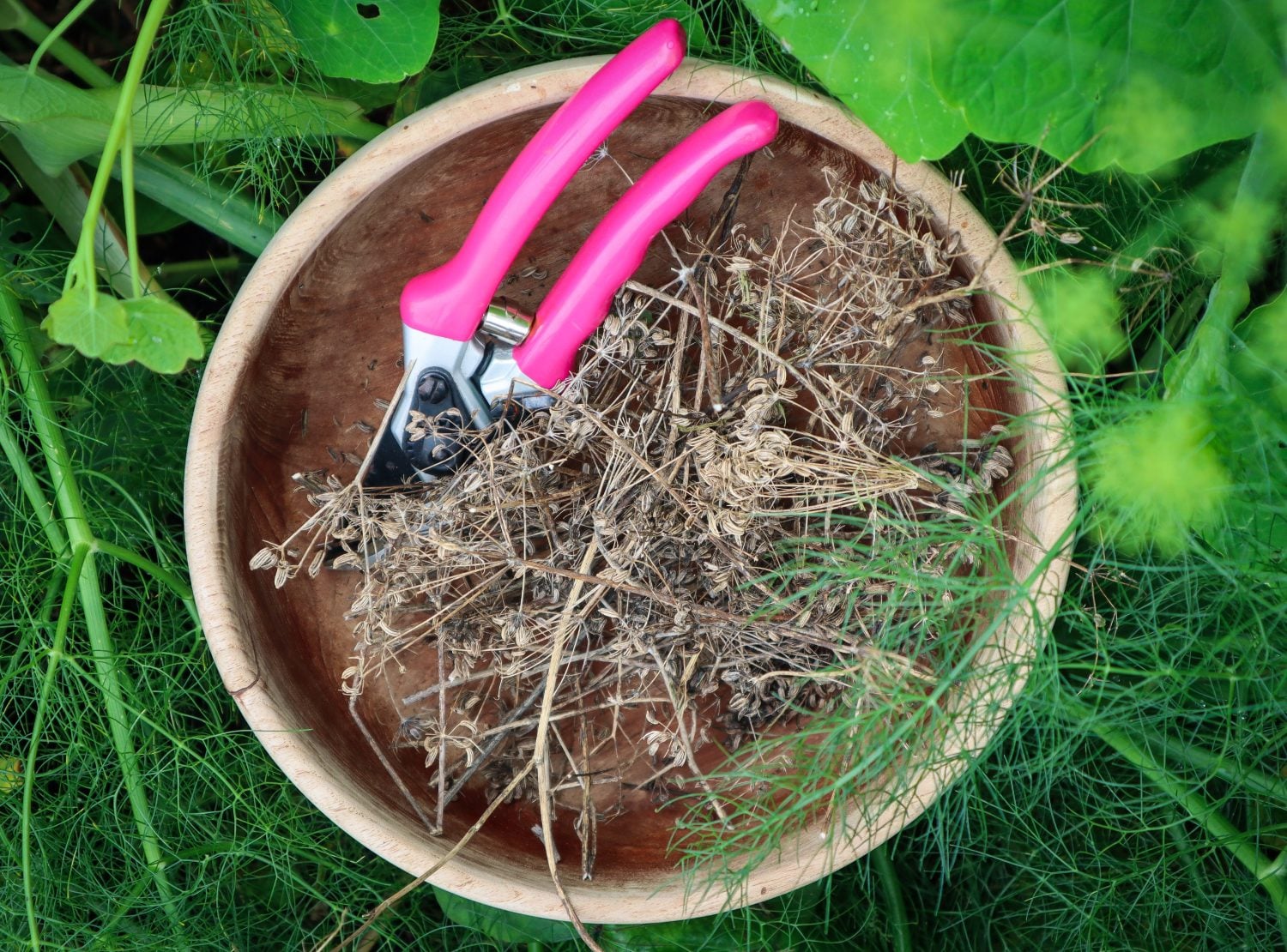
One fennel plant can provide years of future harvests if you save the seeds After flowering, allow the seed heads to dry on the plant. Once they turn brown, cut the stems and hang them upside down inside a paper bag to finish drying.
The seeds have a much stronger flavour than the fronds and are widely used in cuisines around the world. Saving your own seed is also one of the easiest ways to make your garden more self-sufficient.
A quick note on fennel self-seeding: Fennel can be quite vigorous and may self-seed in the garden if left to flower and set seed. In warm climates especially, it can pop up in unexpected places the following season. If you want to control it, simply harvest the flower heads before they fully go to seed, or collect and store seeds intentionally. Either way, it’s a generous plant but it just pays to decide how much you want it to spread.
A Simple Way to Use More of Your Garden
Fennel is one of those plants I never get tired of because you can use so many parts of it. From the bulb to the fronds, then the flowers and seeds, there’s always something to harvest, cook with, or save for later. I really love growing in a way where I’m using as much of the plant as possible. It just naturally creates less waste and a more closed-loop garden where everything has a purpose.
With fennel, the fronds might end up in pesto or soup, the flowers bring in pollinators, and the seeds can be saved or used in the kitchen. Even the leftovers go back into the soil through compost. It’s a nice reminder that nothing really needs to be wasted in the garden…it just gets reused in a different way.
If you found this post helpful, please consider leaving a comment or sharing it with others 💚
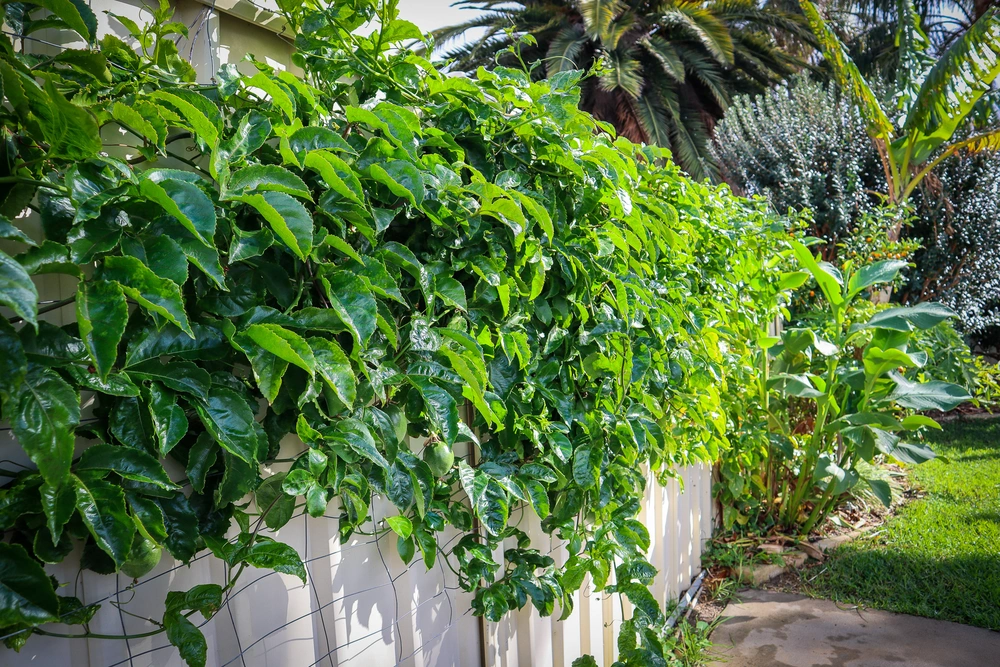
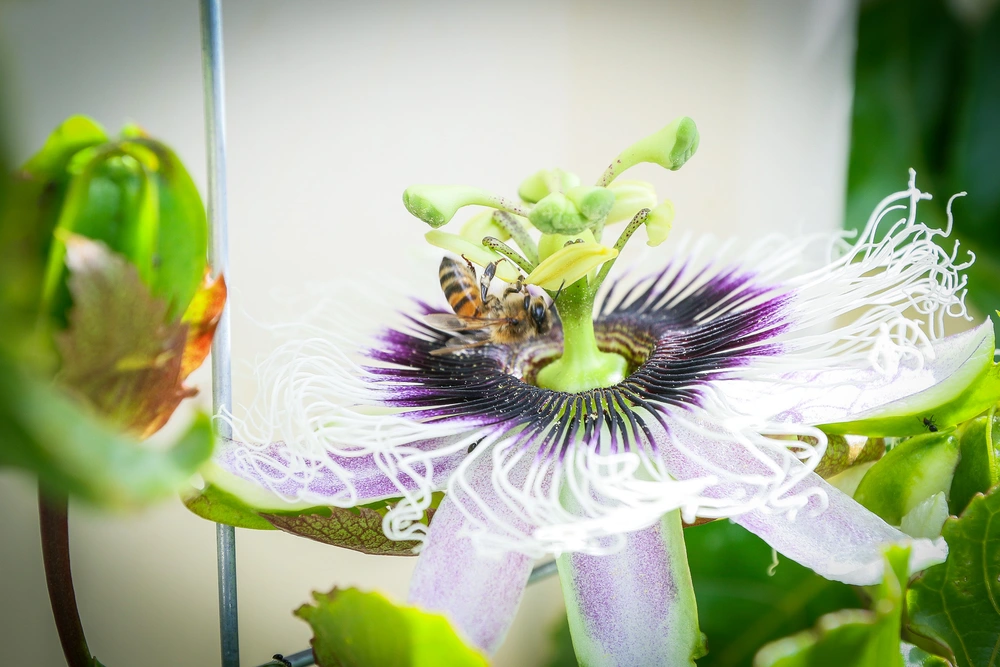
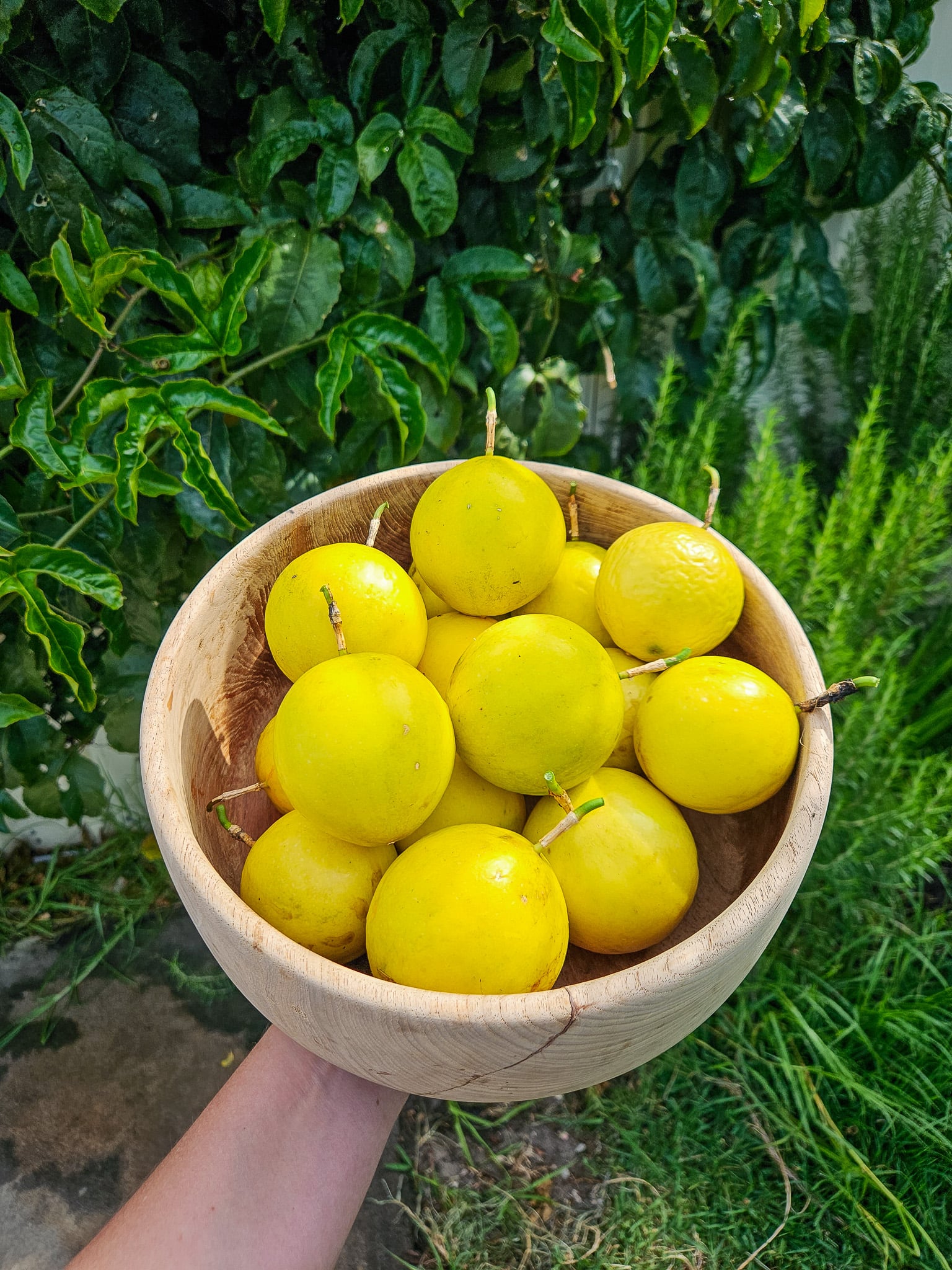
If your passionfruit vine is covered in flowers but not producing fruit, you’re not alone…This is one of the most common (and unexpected) frustrations with growing your own passionfruit at home – especially in warm climates like Perth. The vine looks perfect… vigorous, lush growth, healthy leaves, and plenty of flowers and even bees… but little to no fruit..
It can be so frustrating! I literally spent three years trying to solve this problem! Feeling like you are doing everything right, but you still get no fruit. Passionfruit not fruiting is usually caused by one issue. But the tricky thing is to figure out which exact one is causing the issue with your vine.
I’ve been through this exact situation more than once…I’ve grown many passionfruit vines over the last 10 years, and I’ve had everything from heavy-cropping plants to one vine that looked incredible but only produced three (although extra-large…just three!) fruits in three years! See number 10 on the checklist for this dud variety I ended up removing!
That experience is exactly why I created this guide so that I can help you fix your passionfruit vines or determine if you need to replace them to start getting abundant harvests!
The Troubleshooting Checklist
Passionfruit problems are rarely caused by just one thing, which is why online advice can sometimes feel confusing or even contradictory….One source will say it’s 100% pollination, another will blame fertiliser, and another will point to heat stress…
The truth is: each one of these COULD be the cause, depending on YOUR garden.
That’s why this guide is structured from easiest to hardest fixes. Start at the top and work your way down, eliminating each possibility one by one. You’re not just guessing; you’re narrowing it down until you find the exact issue in your garden.
Once you know the cause, the solution becomes much clearer, and you know you have done everything before choosing whether to replace the vine.
Step 1: Check Pollination (Easiest Fix)
Start here because it’s the quickest and easiest thing to rule out. Passionfruit flowers rely on bees and insects to transfer pollen. Without this step, flowers will open and drop without forming fruit.
Signs this may be the issue:
Flowers open and drop within 1–2 days
No swelling behind the flower after it falls
Very few bees are visiting the vine
What to try: Hand-pollinate a few flowers using a small brush or by picking off one of the pollen-covered stamens and transferring pollen to the central stigma. Do this in the morning when the flowers are freshly open. Later in the day, if there are many bees, they may have harvested all the pollen. This simple test can quickly confirm whether pollination is the problem.
If fruit actually starts to form after hand-pollination, you’ve found your issue.
In most cases, a second variety is not necessary for common passionfruit varieties (Passiflora edulis). Most popular homegrown passionfruit types are self-pollinating, meaning a single vine should still produce fruit if pollination is happening properly.
However… there are some varieties that do need cross-pollination. These are more unique or some of the Panama varieties.
Step 2: Check Water Stress
Inconsistent watering is one of the most common causes of poor fruit set. Passionfruit needs a lot of steady moisture, not cycles of drought followed by heavy watering. This is especially crucial during summer….and no easy task here in Perth 😅 Definitely something to consider before planting is that they do need plenty of water! Sandy soils can also be hydrophobic, and the water you are adding is disappearing before the plant gets a chance.
Signs this may be the issue:
Flowers drop after hot or dry periods
Small fruits form but shrivel and drop off before maturing (most common sign)
Soil dries out completely between waterings
Wilting in the afternoon heat
What to check: Dig a few centimetres into the soil. If it’s dry at root level during flowering, water stress is likely contributing.
Fix:
Deep water 2–3 times per week in summer (more in Perth heatwaves)
Apply thick mulch around the base
Avoid long dry gaps followed by heavy watering
Step 3: Check Heat Stress – Welcome to Gardening in Perth 🙃
Even a healthy vine can stop producing fruit during extreme heat. When temperatures spike, the plant prioritises survival over reproduction. Something we get to deal with every summer here in Perth.
Signs this may be the issue:
Flowers drop during heatwaves
Fruit only sets in cooler months
Vine looks healthy but becomes unproductive in summer
Fix:
Provide more fibre and compost to the soil
Add thick mulch
Add afternoon shade for young plants
Maintain consistent soil moisture during heat spikes
Step 4: Check Nutrient Balance (Too Much Nitrogen)
This is one of the most overlooked problems…Too much nitrogen encourages lush leafy growth, but reduces flowering success and fruit development. Passionfruit are HEAVY FEEDERS. It is important to add plenty of organic material and compost when planting.
Signs this may be the issue:
Very strong green growth but little fruit
Flowers appear but don’t develop further
Vine looks “too healthy” but is unproductive
Small fruits form but shrivel and drop off
Fix:
Stop using high-nitrogen fertilisers and add more potassium
Use compost, worm castings and organic matter instead of quick feeds
Use foliar sprays of diluted compost teas
Step 5: Check Vine Age and Establishment
Sometimes the vine is simply not mature enough yet…and some patience is required (the hardest part). Passionfruit often flower before they are fully ready to support consistent fruiting. But in saying that, my young ‘Sunshine Special’ was planted in Spring and produced fruit in Autumn. Passionfruit also have a short lifespan of 7 years. After that age, they can become unproductive or suddenly die back.
Signs this may be the issue:
Vine is under 1–2 years old
Vine is 7+ years old
Inconsistent fruiting
Vine is only 1- 2 m in size.
Fix:
Allow time to establish strong roots
Avoid heavy pruning too early
Focus on structure and long-term growth
Step 6: Check for Too Much Shade
Passionfruit are often described as hardy vines, but they still need good light to produce fruit properly. One of the most overlooked reasons for poor fruiting is simply not enough sun. A vine can look incredibly healthy in shade…lots of green growth, strong leaves, and even flowers, but still fail to produce abundant fruit. My Panama gold does produce fruit in the shade but I know that I will never get the same yields as if it were in full sun.
Signs this may be the issue:
Large, dark leafy growth, but very few fruit
Flowers appear but don’t develop
Vine is growing well, but struggles during winter and dies off
Located in heavy shade or under dense tree canopy
What to check: Observe how much direct sunlight the vine receives. Passionfruit performs best with full sun or at least 6+ hours of direct light per day.
Fix:
Move vines (if possible) to a sunnier position
Prune surrounding trees to increase light
Train vines up and into higher light zones (pergolas, fences, open structures)
Avoid deep shade positions, even if the vine looks healthy
Step 7: Check If the Plant Is in a Pot
Potted passionfruit vines can grow well for a while, but they often struggle to produce consistent fruit long-term. This is because passionfruit are vigorous, heavy-feeding plants. When confined to a pot, they can become unproductive unless given regular feeds.
Signs this may be the issue:
Lots of leafy growth but poor fruiting
Flowers are dropping despite good care
Little to no flowers forming
Frequent drying out, even with regular watering
Vine becoming root-bound (slowed growth over time)
What to check: Lift the pot slightly if possible. If you see roots circling heavily or emerging from drainage holes, the plant may be root-bound.
Fix:
Move into a much larger container (minimum very large 50L or half-barrel size)
Or ideally plant directly into the ground
Refresh soil and mulch regularly if staying in a pot
Feed with liquid fertilisers such as compost tea, worm castings or pond water every 2-3 weeks
Step 8: Check for Rootstock Takeover (Hard Fix)
One important thing to check is whether your vine is grafted…and if so, whether the rootstock has taken over. In grafted plants, the top fruiting variety is joined to a rootstock. If the graft fails or the rootstock begins to dominate, the plant may become vigorous but unproductive. This is usually the “nelly kelly” variety, and I wish they were never sold here in Perth! I see too many people fail with this issue.
Signs this may be happening:
Very strong growth but poor or no fruiting
Growth looks different below and above the graft union
Shoots are popping up throughout the garden
The leaves have 5 prongs
The fruit is small, orange and red inside
What to check: Look closely at the base of the plant. The graft union is usually visible as a slight bulge or change in stem texture.
If shoots are growing from below this point, they may be from the rootstock.
Fix:
Remove shoots growing below the graft union
Ensure only the grafted variety is allowed to grow
If the rootstock has fully taken over, replacing the plant may be necessary
I would always avoid planting a grafted passionfruit and consider removing it if you have. They can become extremely invasive and can continue to try to take over your garden 50+ years in the future. Check out the YouTube video below for more info.
Step 9: Understand Fruit Drop vs No Fruit Set
This step helps you narrow down the issue more precisely. These are two different problems:
If flowers drop immediately, it’s usually pollination or stress-related.
If small fruit forms but then drops, it’s usually a water or nutrient imbalance.
Understanding this difference helps you focus your attention instead of guessing.
Step 10: Consider Variety or Plant Performance (Hardest Fix)
If everything else checks out and the vine is still not producing, the issue may be the plant itself.
Some vines simply perform better depending on:
Genetic strength
Suitability for your climate
Signs this may be the issue:
Everything is correct but fruiting is still poor
Vine looks healthy but remains unproductive long-term (3+ years)
No clear environmental cause
At this point, the most effective solution may be starting again with a stronger variety suited to your conditions. Passionfruit is usually only productive for 7 years, so you don’t want to spend half of it waiting for it to fruit. Search the variety you have online and see if anyone else is having trouble with it.
I had one vine that I went through this entire checklist and determined that there was nothing else I could do, so I replaced it. I replanted a variety that excels in Perth conditions (Sunshine Special) in the exact same location. Within 6 months, the new vine was covered in fruit! So I knew it was not a soil, water or pollination issue.
P.S. The dud I bought was called “black nugget” so I would avoid that variety. It turned out to be a large gold passionfruit despite the name and with an extremely vigorous vine, intense flowers and just 3 fruits in 3 years!
Quick Troubleshooting Summary
Are bees pollinating the flowers?
Does hand pollination work?
Is watering consistent?
Is heat causing flower drop?
Is nitrogen too high?
Is there too much shade
Has rootstock taken over?
Is the pot too small?
Is the vine still young?
Is the vine too old?
Are fruits forming then dropping?
Is the variety reliable for your climate?
FAQ
Why is my passionfruit flowering but not fruiting?
This is usually caused by poor pollination, heat stress, inconsistent watering, or too much nitrogen fertiliser. In some cases, the vine itself may be an unsuitable variety.
Why do passionfruit flowers drop off before fruiting?
Flower drop is commonly caused by heat stress, lack of pollination, or water stress, especially during hot, dry weather. Or the variety may be unsuitable or unproductive.
How long does it take for passionfruit to fruit?
Most vines begin fruiting within 12–24 months, depending on variety, growing conditions, and whether they are grown from cutting or seed..
Why are my passionfruit small and red inside?
This means the rootstock has taken over. It is important to remove grafted passionfruit as they can be invasive and hard to get rid of! You may notice vines popping up throughout your garden.
Sometimes you need to cut your losses
If your passionfruit vine is flowering but still not producing fruit after you’ve worked through all the possible causes, sometimes the most practical next step is the hardest one…starting again.
It can be tempting to keep waiting, hoping that “next season” will be the one where everything finally clicks. But if you’ve already checked pollination, watering, heat stress, nutrition, shade, and even vine maturity, and you’re still getting little to no fruit, then the issue may simply be the plant itself.
In my own garden, I spent 3 years trying to fix a passionfruit vine that looked perfect but barely produced anything. I changed how I watered, fertilised, pruned, and even hand-pollinated…yet it only ever gave me a handful of fruit. When I finally replaced it, the new vine in the exact same spot was covered in fruit within 6 months!! Which was reassuring, knowing it probably had nothing to do with me or my garden!
That experience taught me something important: sometimes persistence is useful in gardening, but sometimes it just turns into years of waiting for a plant that was never going to perform well in the first place.
If you’ve truly tried everything on this list, don’t be afraid to reset. A healthy, well-suited vine planted in the right conditions can outperform a struggling plant by a huge margin…and get you enjoying harvests far sooner than waiting another few seasons for a vine that still isn’t delivering 🫠
In gardening, knowing when to move on can be just as powerful as knowing how to fix the problem.
If you found this post helpful, please share it with others to help them get better harvests 💚
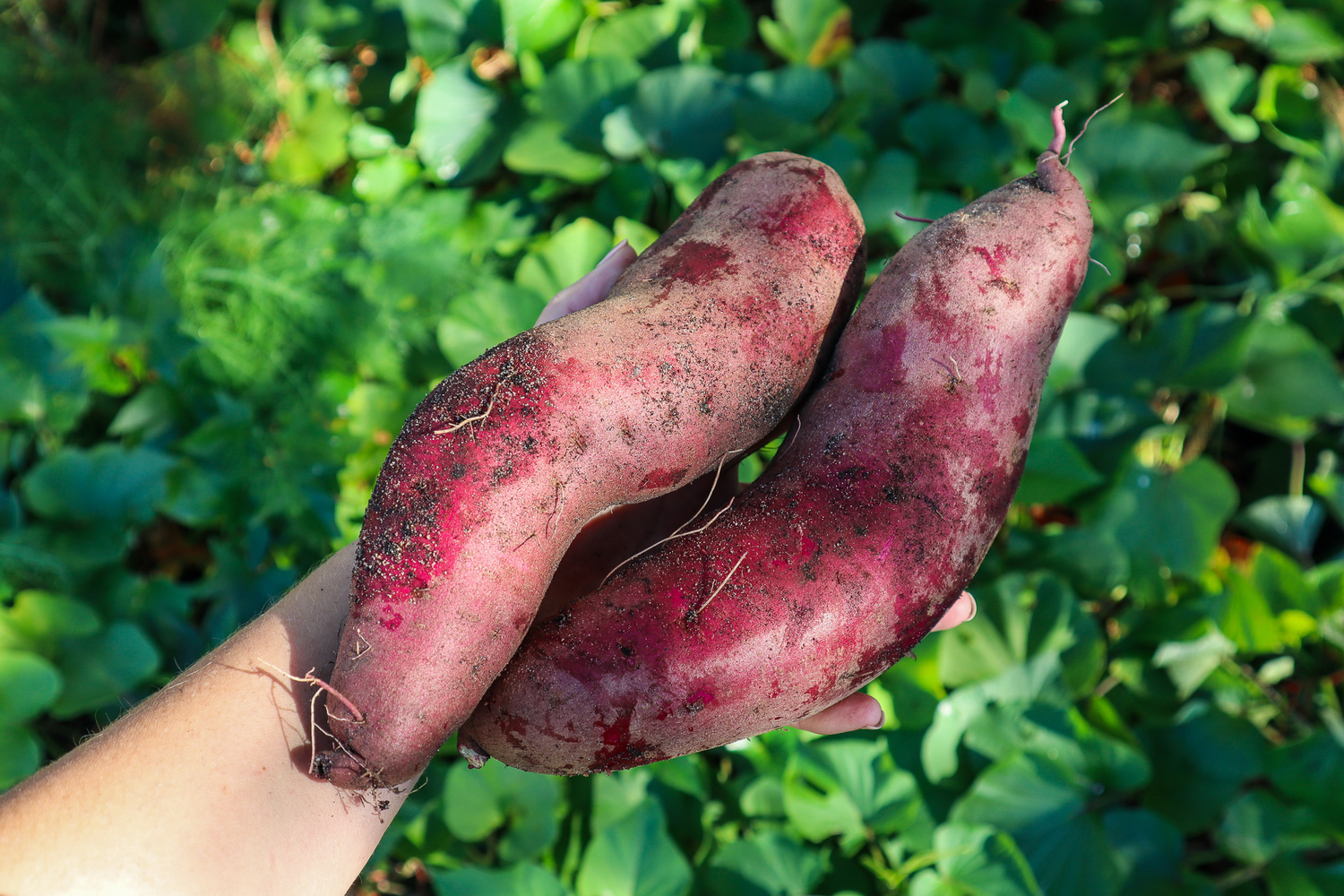
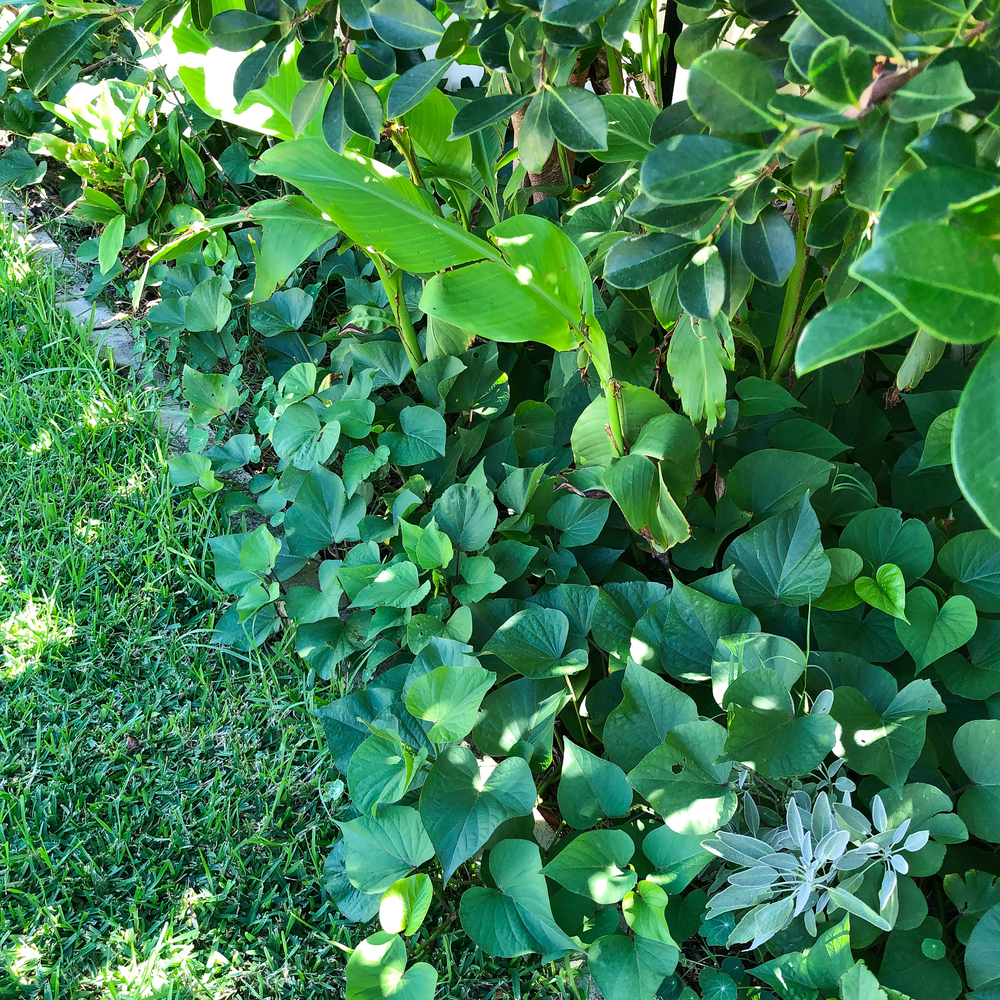
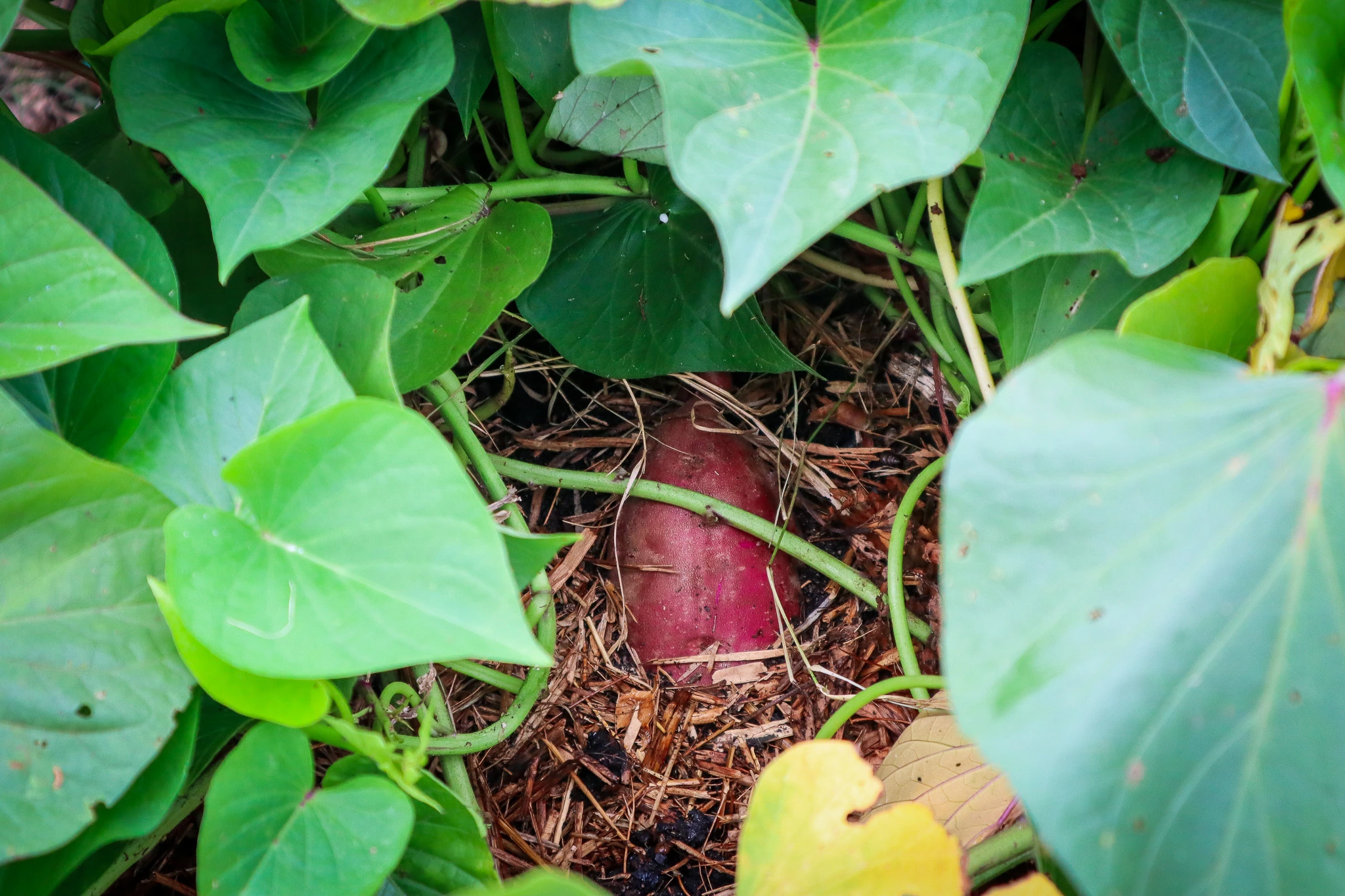
Sweet potatoes are one of those plants that can make you feel like a very successful gardener… right up until you actually try to harvest them, and then it’s just leafy sweet potatoes with no tubers…They are fantastic edible ground covers as the vines take off fast. They creep through garden beds, over mulch paths, into neighbouring plants. In a food forest setup, they look like they’re doing exactly what they should be doing…covering soil, producing biomass, filling space.
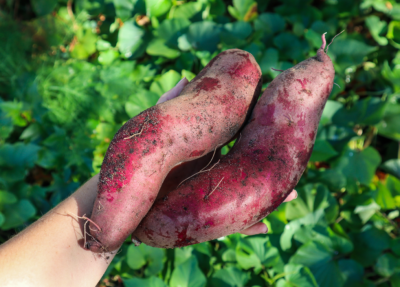
It all looks very lush and productive….And then you dig… And there’s not much there. Maybe a few small tubers. Maybe nothing worth the effort. If that sounds familiar…this post could be the answer to your problems! I posted my recent sweet potato harvest over on my Facebook and had so many people sharing that they struggle to get a decent crop of tubers…
This is one of the most common sweet potato growing problems, especially in warm climates like Perth, where vines grow aggressively but tuber formation can be inconsistent.
And the strange part is… the plant is clearly healthy. So what’s going on? If you’re getting sweet potatoes all leaves and no tubers, it is almost always the same issue.
It comes down to one common mistake. In my gardens, I grow sweet potato in two very specific ways to get two very different outcomes. One is for a root crop, and the other is for a living ground cover. Today, I am going to share 5 Practical Solutionsto Fix Leafy Sweet Potato Vines.
What’s Actually Happening?
Sweet potatoes are a storage crop.
Leaves = energy production (photosynthesis)
Vines = growth and expansion
Tubers = stored energy (your harvest)
When conditions favour vine growth over storage, the plant puts all its energy into leaves and runners instead of developing the sweet potato tubers. This is great if you want an edible ground cover…but not so great if you want a bumper harvest of tubers..
The Most Common Reason For Sweet Potato Vines with No Tubers
This is probably the most common reason I see most sweet potato crops fail…and is often overlooked.
Many gardeners:
Plant just one sweet potato slip (/cutting or sprouted sweet potato)
Let it trail freely across the garden bed
Allow vines to root along multiple points and “create new plants”
Why this reduces harvest
When vines touch soil and root:
The plant redirects energy into new root systems
Each rooted node becomes a “new plant section”
Energy gets spread across many growing points instead of one storage zone
Result: A massive lush vine (great as a living ground cover), but small or underdeveloped tubers.
5 Practical Solutions to Fix Leafy Sweet Potato Vines
1. Don’t let one slip become an entire system– if you want a large harvest
This is where I have two different ways of growing sweet potatoes.
I let them trail through parts of my food forest as a living ground cover. But the aim of this is not to dig up all the ground and get huge root crops. The aim is to cover the soil and keep the water retention during summer.
For my main crops of large sweet potato tubers, I plant many slips (rooted cuttings) in a confined area such as a raised garden bed or section of the food forest. I also train the vines vertically to reduce space and stop them re:rooting. Don’t rely on one main plant to give you a large harvest. Plant slips 30–40 cm apart.
2. Stop allowing vines to root everywhere (MOST IMPORTANT)
Instead:
Lift vines periodically
Keep them on top of heavy mulch
Prevent nodes from rooting into soil
OR
Train vines vertically up an arbour or fence ( my go-to method). This can create bonus shade and cool down your summer garden.
3. Keep soil balanced, not overly fertilised
Before planting out your sweet potato, add compost and worm castings for structure and nutrients, and a thick layer of mulch for water retention. You want steady growth, not explosive foliage.
4. Water consistentlyduring summer
Sweet potatoes do best with:
deep watering
even moisture
no big swings between dry and saturated
Sweet potatoes are pretty drought-tolerant and can happily grow through dry periods, but they will focus their energy on leaves and vines rather than tubers. Consistent watering is what signals “it’s safe to store energy now.”
5. Give them space and time
Sometimes the best thing you can do is stop checking too early….Plant your slips in spring and wait until late autumn or early winter to start checking.
Look for:
Signs of sweet potatoes popping up through the soil
Slowing down of growth and the leaves starting to look damaged or yellow.
That’s when tubers finally start to bulk properly.
Are sweet potatoes still good as ground cover?
Yes, but with intention. In food forest systems, sweet potatoes can still function as:
But the key difference is understanding that this may have a smaller root crop.
Unmanaged spreading = more vine and leaves Managed spreading = food crop + ground cover balance
Utilise the whole plant – the leaves are edible too!
Not every sweet potato planting has to be about digging up big tubers. In my food forest gardens, I use sweet potatoes more as a living mulch layer spreading across the soil, shading roots, suppressing weeds, and filling space between larger plants. And in that system, even if tuber production is lower, the plant is still producing something useful the entire time.
One of the most underrated parts of sweet potatoes is the edible leaves and young shoots. Stir-frys,soups and curries are a great way to utilise your abundant sweet potato leaves.
FAQ: sweet potato growing problems
Why don’t my sweet potatoes form tubers?
The biggest causes are vines rooting along nodes, not planting enough slips or harvesting too early.
Can you grow sweet potatoes in Perth?
Yes. Very successfully. But Perth’s sandy soils and irregular rainfall often amplify sweet potatoes no tubers issues unless watering and vine control are managed.
Can I grow sweet potatoes in a food forest?
Absolutely. But they perform best when vine spread is guided rather than left to root freely everywhere.
Can sweet potatoes grow vertically?
Yes! Sweet potatoes can grow very well vertically along trellises, fences, or raised structures. In fact, vertical growing can be a great way to manage space and control vine growth to get bigger harvests!
Are sweet potato leaves edible?
Yes – young sweet potato leaves and shoots are edible. They’re best used as a cooked green rather than raw.
What do sweet potato flowers mean?
It generally means the plant is healthy and not under major stress. But it’s more of a “maturity signal” than a harvest guarantee.
Intentional Garden Design Choice, Not a Failure
At the end of the day, this isn’t really about sweet potatoes failing to make tubers. It comes back to the same simple issue…the #1 mistake of letting vines sprawl and root freely, which spreads the plant’s energy too thin.
Once that happens, the plant shifts away from storage and into vine production, giving you lots of leaves but very little harvest. But now that you know this, you can actually choose the outcome for your garden!
Sweet potatoes can be grown in two main ways:
a leaf-focused system, where they act as ground cover and edible greens
a tuber-focused system, where vines are kept more controlled, and energy is directed underground
Neither is wrong…it’s just different functions in a food forest.
If you found this post helpful, please share it so more people can find the answer to their small sweet potato harvests 💚
As a Kiwi living in Perth, Feijoas (also called pineapple guavas here in Australia) are a must-grow in my garden! One of the easiest fruit trees to grow in a home garden, but many gardeners get confused about when to prune feijoa trees. Prune too hard at the wrong time…and you can accidentally remove next season’s fruit (which is less than ideal!). Leave them untouched for too long, and they quickly become dense, leggy, and difficult to harvest (or shade out too much of your garden).
But…Feijoas are incredibly forgiving once you understand their growth habits. So in this guide, you’ll learn exactly when to prune feijoas,whether you even need to prune feijoas, how to prune feijoa hedges and the best pruning tips for healthier trees and bigger harvests. And not to be scared to give them a good hack back!
Why Pruning Feijoas Helps Production
Regular pruning helps feijoa trees:
Improve airflow and reduce disease
Produce stronger, healthier growth
Allow more sunlight into the canopy
Make fruit easier to harvest
Prevent trees from becoming too tall or dense
Encourage productive new branches
Fruits often form on the new growth
Allows size to manage netting for fruit flies or birds
Without pruning, feijoas often develop thick, unproductive branches, while the inside becomes shaded and leggy. Also regular pruning provides regular green material to turn into mulch and feed your garden! Win-win!
Do You NEED To Prune Feijoa?
Pruning Feijoas is important to maintain size and promote new healthy growth, but when they are young or still small, they may not need much pruning at all. When you first plant a feijoa tree, it can be a good idea to remove low-down side branches to allow a single main trunk. This would be for the first 40 – 50 cm. After that, you can tip prune the ends to create a bushier tree.
When to Prune Feijoas
The best time to prune feijoas is immediately after fruiting finishes, usually in late autumn to early winter.
This timing is important because feijoas produce fruit on new growth that develops from older wood. Pruning after harvest gives the tree time to recover and produce fresh growth before flowering begins again in spring.
For those of us growing in Australia and New Zealand, this means pruning feijoas between May and July. Each tree and variety will have different timing, but just try to stick with as soon as you can get out there after they have finished fruiting.
What Happens if You Prune Feijoa Trees too Late?
The later you leave pruning, the closer it gets to spring. Spring pruning is one of the biggest mistakes gardeners make with feijoas. At this stage, the tree is about to start producing flowers and new fruiting wood. Heavy pruning can remove flower buds and significantly reduce your harvest. Light trimming or removing damaged branches is usually fine, but save major shaping for after harvest. It can also put the tree under stress, and it will push out a lot of new growth, but no flowers. If this does happen and you prune your feijoa trees too close to spring, don’t stress, you may get a smaller fruit yield that year, but the following year it will likely put out a large crop.
Signs Your Feijoa Tree Needs Pruning
Your feijoa will benefit from pruning if you notice:
Dense tangled branches
Poor airflow through the centre (black fungus on leaves)
Fruit is only forming on the outer edges
Tall upright growth that’s difficult to harvest
Dead, damaged, or crossing branches
Reduced fruit production
Even older neglected feijoas can often bounce back surprisingly well with gradual pruning over a few seasons.
How to Prune a Feijoa Tree to Maximise Fruit
Feijoas respond best to gentle shaping rather than aggressive cutting.
1. Remove Dead or Damaged Wood
Start by pruning:
Dead branches
Diseased wood
Broken stems
Low weak growth
Branches are going off in undesired directions (into the fence, over other fruit trees)
This immediately improves airflow and tree health.
Pruning can feel overwhelming at first, but with all my fruit tree pruning, I find it easiest to start with removing branches I know I don’t want to keep. This can be due to the direction they are growing, damaged or unhealthy limbs, or reduced height or size.
2. Open Up the Centre
Feijoas naturally become very dense. Thin out crowded inner branches to allow sunlight and air into the middle of the tree. This helps reduce fungal issues and encourages productive growth throughout the canopy.
3. Reduce Height if Needed
If your tree has become too tall, selectively shorten upright branches. I find my trees put on 1/3 rd of their height in new growth during spring. So if you reduce the size by 1/3rd, they can be maintained to stay around the same height. Aim to keep the tree at a manageable harvesting height or for netting. I like to keep my trees at a height I can easily reach the fruit, but this will depend on your space and preferences.
4. Shape the Tree Naturally
Try to maintain the feijoa’s natural rounded form. Avoid over-pruning into stiff hedge-like shapes unless you are intentionally growing a hedge. Keep a clean and clear trunk at the base.
Can You Hard Prune Feijoas?
Yes, mature feijoas can tolerate fairly hard pruning if needed. Every few years i will do a harder prune to 50% and remove larger limbs that are growing in the wrong direction (over my neigbours fence 😅. If your tree is severely overgrown, you can gradually prune it over 1–3 years by removing larger branches bit by bit rather than all at once. A heavy prune can result in less fruit that season, depending on how stressed the tree is and what time of year you prune. (see when to prune section)
Heavy pruning may temporarily reduce fruit production, but the tree usually rebounds with vigorous new growth and high yields the following year. and if you have more than one tree you can still get a harvest (I may have 4 trees…so there is no chance I skip a season haha).
What Tools Do You Need? And What To Do With The Pruned Material?
One of the main reasons I prune my feijoas every year is to keep the size manageable, not only for the tree but also for the size of the pruning material (branches and limbs). Smaller branches can be cut using extendable pruning loppers or small saws (I love a receprical saw for the larger branches), and for hedges and light tip pruning and shaping, I use extendable hedge trimmers. I then run the small branches through a small mulcher to create my own mulch!
Tips for Pruning Feijoa Hedges
Feijoas also make excellent edible hedges. They have dense evergreen foliage that provides privacy and wind protection all year round. Hedging can produce decent amounts of fruit, especially if you have many trees planted together, but it will often be less productive than a stand-alone tree due to the heavy pruning and density of growth. Usually, you will find the trees on the ends will be more productive for this reason.
For hedge-style feijoas:
Lightly trim 1–2 times per year but avoid late winter or spring pruning.
Keep the base wider than the top so sunlight reaches lower branches
Avoid constant tight clipping, which can reduce fruiting
If fruit production is your priority, allow some branches to grow more naturally instead of pruning heavily.
How to Maximise Fruit Production in a Feijoa Hedge?
Most people will use generic seedling feijoas for hedging because they are often easy to find and affordabe price to, but enough to make a hedge. Generic seedling feijoas can take 5+ years to start fruiting, and they are not always great producers. Some have small fruits, and some don’t produce many at all. My top tip to grow a feijoa hedge…or any feijoa tree for that matter, is to purchase a grafted “named variety”. These will be found at more fruit tree-specific nurseries and will have names like “duffy”‘ “triumph” or “white goose”. The names will be different whether you are located in NZ or Australia, as we have different cultivars, but choosing one of these will be MUCH MORE productive than a generic “Feijoa sellowiana”
What Happens If You Never Prune Feijoas?
Unpruned feijoas often:
Become very tall
Have large, thick limbs that produce no fruit
Make it harder to prune in the future, as bigger pruning tools are needed
Develop dense outer growth
Produce smaller fruit
Have reduced airflow and light penetration
Fruiting shifts further from the centre to the edges
A little yearly maintenance makes a huge difference over time.
Extra Feijoa Growing Tips
To keep feijoas thriving after pruning:
My NUMBER 1 TIP: Purchase a named variety (grafted); this will give you faster fruit and larger crops!
Plant multiple varieties nearby for improved pollination and larger harvests (one is fine and self-pollinating, but multiple will increase this)
Mulch heavily around the base – they have shallow feeder roots
Water deeply during summer – this is when they are developing fruits, so they need the most water (which happens to be the driest period here in Perth…)
If you’re looking for the best vegetables to plant in autumn in Perth (zone 10b), these 15 vegetables and herbs will set your garden up for a productive season. After months of trying to keep the garden alive through relentless heat, autumn gardening in Perth feels like a breath of fresh air.
This is the season where growing food in Perth actually starts to feel enjoyable again (my favourite season!)….and it’s when my garden puts on some of its best growth all year.
If you’ve been waiting for the right time to start a veggie garden or refresh tired summer beds, it doesn’t get any easier than Autumn (if you can get the pests in check…don’t worry, I will share my top tips for this at the end of the post!).
In this post, I wanted to share 15 vegetables that genuinely thrive during autumn in Perth, along with bonus tips on how to sow and get the most out of your harvests!
Why Autumn Is One of the Best Gardening Seasons in Perth
One of the biggest mistakes I see beginner gardeners make in Perth is trying to start everything in the middle of summer. Our summers can be brutal. Between the dry heat, intense sun, warm nights, and sandy soil that dries out quickly, young seedlings can struggle fast. I do very little planting in summer.
Autumn, everything starts bursting out of the soil! I let a lot of plants go to seed, so my gardens often have seeds popping up everywhere! Including cracks in the pavement and lawn. The soil is still warm from summer, which helps seeds germinate quickly, but cooler air temperatures dramatically reduce stress on plants (and help retain moisture!). It’s this sweet spot where growth really takes off again.
I honestly find autumn gardening the MOST enjoyable. Instead of constantly trying to save plants from heatwaves, you can focus on building healthy soil, succession planting, and enjoying the garden again. Take the time to slow down, observe and enjoy your garden!
I recently shared a full autumn garden tour over on YouTube, showing what’s growing, what I’m planting right now, and how the food forest is transitioning into the cooler season 👇
15 Vegetables and Herbs to Grow in Autumn (Perth)
Lettuce
Lettuce absolutely shines in autumn. During summer, it bolts almost instantly in my garden (or just goes pure crisp!), but once the weather cools down, it becomes one of the easiest and most rewarding crops to grow. I love filling gaps throughout my raised garden beds with loose-leaf varieties because you can harvest them continuously over months.
SOWING TIP: Lettuce seeds are delicate, so don’t bury them too deep. I sprinkle them on the surface and only barely cover them with a light sprinkle of soil (or none at all).
ABUNDANCE TIP: I let a lettuce go to seed every year (around spring / early summer), and the seeds fall into the soil and regrow on their own once the weather cools in autumn! I literally did not plant lettuce this year, and yet I have 100s of plants throughout my garden (and the lawn and pavers). Or pop the seed head upside down in a paper bag and dry out for the next season.
Carrots
Carrots grow well during Perth’s cooler months. The milder temperatures help roots develop properly without the stress and inconsistent growth that often happens during hot weather. One thing that’s made a huge difference in my sandy soil is keeping carrot beds consistently moist during germination.
SOWING TIP: I like to lay the seeds directly on the surface and cover with a hessian sack or a plank of wood. Come back and check in a few days to see when they have sprouted. This keeps them moist, stops them blowing away, or birds eating the seeds. I like to sow seeds every couple of weeks for an extended harvest.
ABUNDANCE TIP: Let a carrot continue to grow until it flowers and goes to seed. Not only will the bees and beneficial insects love you, but you will get 100s of free carrot seeds. I find that carrot success is in overplanting, so having excess seeds is always a huge benefit.
Pineapple Sage
This is my favourite herb! I have not had success growing it as a perennial in my garden, so it is something I replant every autumn. Sweet, fragrant leaves and edible flowers, pineapple sage is amazing in teas, salads, and baking. Plus, the small birds love harvesting the nectar from the bright red flowers.
GROWING TIP: I suggest planting from a seedling. They like a warm sunny spot with adequate watering. I have struggled to grow this in the past, so I tried a few different spots in the garden until I found a place where it was happy!
ABUNDANCE TIP: Prune or pinch out the tips of the plant to encourage a bigger, bushier shrub. Once established, pineapple sage becomes an incredible living pollinator plant in the food forest. Helping your fruits and veggies get better pollination (and grow more fruit).
Spinach
Spinach thrives once temperatures cool down. I grow a mix of traditional spinach and perennial spinach throughout autumn because they produce so much reliable food. NZ spinach/ Warrigal greens makes a great living ground cover. Longevity Spinach is packed with so many nutrients and grows easily from cuttings. Traditional spinach in the raised garden beds offers a regular supply of cut-and-come-again greens.
SOWING TIP: Keep spinach consistently watered while young to encourage tender leafy growth. I like planting it along bed edges where it’s easy to harvest regularly.
ABUNDANCE TIP: Perpetual spinach can continue producing for months if regularly harvested. Instead of removing the whole plant, pick the outer leaves continuously for a much longer harvest. Perennial spinach, such as NZ Spinach, Brazilian Spinach, Longevity Spinach, Okinawa Spinach, Malabar Spinach or Chaya (tree spinach) are a great way to have a continuous supply of leafy greens.
Peas
Peas are one of those crops that instantly make the garden feel productive again. Autumn is the perfect time to sow them in Perth because they establish well before winter and love the cooler nights. I usually grow climbing peas along trellises on the back (southern) side of my raised beds, which helps maximise space (without shading out the other plants) while creating beautiful vertical greenery.
SOWING TIP: Peas germinate best in consistently moist soil, so don’t let young seedlings dry out during establishment. Trellising early also makes a huge difference once growth takes off.
ABUNDANCE TIP: Leave the roots in the ground after harvesting. As legumes, peas help add nitrogen back into the soil, which benefits the next crop planted nearby. Leave some peas to fully mature on the plant and save your own seeds. Seeds that have grown from plants in your garden will be well adapted to growing in your exact conditions.
Broccoli
Broccoli can struggle badly in heat, but autumn gives it the conditions it actually wants. This is the time I start planting out seedlings so they can mature through winter. A big lesson I’ve learnt with broccoli is not to skimp on soil fertility. Heavy-feeding crops like this need rich compost soil and consistent moisture to really thrive. I love to grow purple broccoli because it adds colour to a winter garden!
GROWING TIP: Mulch heavily around broccoli seedlings early. This helps regulate soil moisture and reduces stress while the plants establish. I tend to plant seedlings rather than seeds because they do take a while to grow, so you want to make sure they have enough time to produce before the spring heat arrives. So seeds in late summer to early autumn or plant seedlings in mid-late autumn.
ABUNDANCE TIP: The leaves are edible, too! Chop up and cook the leaves just like you would chard for a nutritious bonus harvest! Just take a few from each plant so that there are still plenty of leaves for the plant to grow. Often, if you cut the main head off, some side shoots will appear, so leave the plant in the garden for some smaller side shoots.
Kale
Kale is one of the easiest and most reliable vegetables in my autumn garden. Once established, it handles cool weather beautifully and produces continuously for months. It’s also one of those crops that makes the garden feel abundant because you’re constantly harvesting leaves without needing to replant immediately.
GROWING TIP: Not all Kale is the same…some are spikey and tough. Try out a few varieties and see which one you prefer. My favourite is the Black Tuscan Kale. It is smoother and easier to use meals.
ABUNDANCE TIP: Rather than harvesting the entire plant, pick the lower leaves continuously while allowing the top to keep growing taller. I also prune my kale in spring and let it grow through summer. This means come the following autumn, you already have an established plant ready to start producing!
Beetroot
Beetroot grows surprisingly easily during autumn and doesn’t need a huge amount of space. I often tuck beetroot throughout raised beds and around larger crops because it fits into small gaps really well. The cooler weather also helps produce sweeter roots. For sweeter, less earthy-tasting varieties, try the Golden Beetroot or Chioggia candy-striped Beetroot.
SOWING TIP: Sow directly where you want them to grow because beetroot dislikes being transplanted. Keeping soil consistently moist helps improve germination rates. Sow multiple seeds 2-3 weeks apart for a continuous harvest.
ABUNDANCE TIP: Don’t forget the leaves! Young beetroot greens are delicious and productive long before the roots are fully mature. They are part of the chard family, so you can use the leaves and stalks in soups and stir-fries just like you would silverbeet or chard. Just harvest a few from each plant so they still have enough energy to produce healthy roots.
Cabbage
Autumn is the perfect time to establish cabbages before winter. I’ve found they perform much better once the cabbage moth pressure starts easing compared to spring and summer. Here in Perth, our winters can be short. I love to grow the smaller mini cabbage varieties (Diggers Seeds).
SOWING TIP: Cabbages are heavy feeders, so I always plant them into beds with plenty of compost and organic matter already added. I like to plant cabbage from seedlings, as they can be slow-growing, and pests do love to eat them when they are young. Late summer and early autumn, sow seeds in seed trays. Late autumn or early winter, I would stick to seedlings to have enough time for them to form before the hot weather arrives in spring. Because cabbages a low-growing plant, plant them on the northern or western side or edge of your garden beds, so they don’t get shaded out by taller plants.
ABUNDANCE TIP: Smaller “mini” cabbages not only take up less room (allowing you to fit in more plants), but they are also the perfect size to make sure none goes to waste.
Parsley
Parsley is such an underrated herb in an edible garden. Once the weather cools, it explodes with growth and becomes one of the easiest productive herbs in the garden. It’s also fantastic for filling edges throughout a food forest system. I often cut back extra growth to use as chop and drop mulch. Fresh parsley can be topped on so many meals or added to salads for a boost in nutrients.
SOWING TIP: Parsley appreciates regular moisture while establishing. Once settled in, though, it becomes surprisingly resilient. I tend to direct sow into the garden.
ABUNDANCE TIP: Allow some parsley plants to flower. The flowers attract huge numbers of beneficial insects and pollinators into the garden. Then the seeds can scatter to regrow in their own next autumn. Free plants and zero effort gardening! If you want to extend your growing season and keep parsley well into spring and summer, sow some in a shady part of your garden. This can help stop it from going to seed and allow longer harvests.
Radish
Radish is perfect if you want quick results. Some varieties go from seed to harvest in just 4 weeks, making them ideal for filling empty garden spaces while slower crops establish. They’re also one of my favourite crops for beginner gardeners because they give such fast rewards. If you are not a fan of radish, try roasting them! So delicious.
SOWING TIP: Sow radish frequently and in small batches rather than all at once for a continuous harvest. I sprinkle seeds in the gaps after I have planted in my large crops like cabbage and cauliflower.
ABUNDANCE TIP: Allow a few radishes to flower and go to seed. The young green seed pods are edible, and the flowers are loved by pollinators. Once the seed pods go brown, dry and crack open to release the radish seeds. The leaves are also edible and can be used in meals like soup, pesto or chimichurri.
Spring Onion
Spring onions are one of the lowest-maintenance crops I grow. They fit almost anywhere, handle cooler weather well, help repel pests and are incredibly useful in the kitchen. I usually scatter them throughout beds rather than planting in neat rows. They grow quickly and are much easier to grow here in Perth with our short, mild winters.
SOWING TIP: Direct sow spring onions densely around the gaps between larger crops to maximise small spaces throughout the garden.
ABUNDANCE TIP: Instead of pulling the whole plant out, cut above the roots and allow them to regrow multiple times.
Rainbow Chard and Silverbeet
Rainbow chard is a staple must-grow in my autumn and winter gardens. I love the bright colours, and it provides continuous (generous) harvests through the cooler months. It’s one of those dependable crops that keep producing even when other plants struggle.
SOWING TIP: Give chard/silverbeet plenty of compost and regular water for lush leafy growth. Direct sow or seed trays, but I tend to direct sow mine.
ABUNDANCE TIP: Harvest outer leaves continuously instead of removing the whole plant. One or two healthy chard/silverbeet can feed you for months!
Asian Greens
Pak choi, bok choy, tatsoi, and other Asian greens thrive during autumn and winter when it cools down. They grow quickly and are perfect for succession planting. Early autumn in Perth can still be quite warm, plant asian greens mid-late autumn to reduce the chance of them bolting and going straight to flower.
SOWING TIP: Asian greens grow incredibly fast, so sow regularly every couple of weeks for constant harvests. Direct sow and seed trays, as they can be eaten by pests when they are little.
ABUNDANCE TIP: Cut with a sharp knife at the base instead of removing the whole plant, and they can regrow to get multiple harvests.
Cauliflower
Cauliflower can be a little slow and patience-testing at times, but autumn gives cauliflower the stable conditions it needs to properly develop. I love to grow the Purple Sicily variety for the bright colour it adds to the garden; it tastes good too!
SOWING TIP: Sow in seed trays and plant out seedlings in Autumn. Enjoy the soil has fresh compost as they are quite heavy feeders.
ABUNDANCE TIP: Don’t pull the whole plant out after harvesting the main head. Some varieties continue producing small side shoots, which give you extra harvests from the same plant. Plus, the leaves are edible too! Great for slicing into soups and stir-fries.
My Biggest Autumn Vegetable Gardening Tips for Perth
1. Plant Extra
Sow a few rounds of seeds or seedlings as backups in case the pests get to them first. Slugs and snails are busy during the cooler months, and it’s best to hang all your hopes on a select few seedlings.
2. Focus on Soil Building
Early Autumn is the perfect time to add compost, worm castings, and organic matter back into tired summer beds.
3. Plant Little and Often
I usually pop a few seeds in for successional sowing or as backup reserves every couple of weeks, which creates more consistent harvests.
4. Don’t Rush Winter Crops Too Early
Even though it’s cooling down, early autumn days can still be quite warm in Perth. Timing matters. I would plant asian greens mid-late autumn to reduce bolting.
How to Stop Pests from Eating Your Seedlings in Autumn?
Over the last 10+ years, growing my own food here in Perth, I have tried many different techniques to reduce pest pressure during the cooler months. These are the most effective solutions I have found.
1. Used Coffee Grounds
This is really my number one secret weapon for stopping the slugs, slaters and snails eating my young seedlings!! I pick up bags of used coffee grounds from a local cafe for free – saves them going to landfill and makes a huge difference to my garden! Grounds that have been through a large machine with water are close to pH neutral. We also have naturally alkaline soil and water here in Perth, so if there was any slight acidity left, this would help balance that out. Apply small sprinkles over your seedlings.
NOTE: This does need to be regularly applied after any watering or rain. I usually just find the bigger chunks from the last application and re-crumble them on top.
2. Remove Lower Leaves
As your seedlings start to grow and get large enough that their leaves touch the soil. Start to remove the older leaves. The leaves that touch the soil act as a ladder for pests.
3. Plant Extra
In a natural garden, pests are totally normal! I would be more concerned if nothing wanted to eat your veggies! Plant extra so that you always have some backups available and more chance of getting a productive harvest.
🎥 A Look Around My Autumn Food Forest
This season is honestly one of the busiest and most exciting transitions in the garden. The sweet potatoes are slowing down, new greens are filling the beds, and the entire space is shifting back into lush growth again after a crispy summer. There’s something really motivating about seeing fresh seedlings establish quickly after months of struggling through heatwaves 😅
If you’d like to see exactly what’s happening in the garden right now, I shared a full autumn garden tour here:
Autumn gardening in Perth truly is one of the best times to grow food. The combination of warm soil, cooler air, and reduced plant stress creates incredible growing conditions for so many vegetables. Whether you’re starting a new garden, refreshing old beds, or simply trying to grow more food at home, this is such a rewarding season to lean into.
Start with a few vegetables that thrive in cooler weather, focus on building healthy soil, and let the garden evolve season by season 🌿
Wondering whether to plant a dwarf or standard fruit tree? This guide breaks down the differences, wind resistance, harvesting, and space requirements for urban gardeners. As someone who grows a lot of fruit trees in a small space…dwarf fruit trees are something I use intentionally in my urban permaculture garden but…
There are some big misconceptions when it comes to dwarf fruit trees.
Dwarf and semi-dwarf fruit trees allow me to fit more varieties into my urban food forest (heck yes!) and reduce the amount of work I need to do in terms of pruning (also heck yes!) … because when you’re looking after 100s of trees, this makes a difference! But not all dwarf fruit trees are equal!
Over the years, I’ve realised that a lot of people misunderstand what “dwarf fruit trees” actually means. So in this post, I want to break it down:
What does a dwarf fruit tree really mean?
How do they differ from semi‑dwarf and standard trees?
How to decide if dwarf or standard fruit trees are best for your garden?
What are other ways to keep fruit trees smaller?
Do standard fruit trees live longer?
What Do “Dwarf Fruit Trees” Actually Mean?
When we talk about dwarf fruit trees, we’re not talking about a different type of fruit. We’re talking about athe rootstock.
If you get, for example, a Meyer lemon, it might come in dwarf, semi-dwarf, and standard. The actual Meyer lemon tree and genetics are the same across all 3.
The fruit will be the same size, same colour, same flavour, the leaves the same, everything is genetically the same. The difference is that they are all grafted onto a different rootstock.
Rootstocks are usually seed-grown or cloned for specific traits.
Dwarf rootstocks grow slowly, and the root systems are smaller and less vigorous. This means the trees stay small and dwarfed. Standard sizes, however, will utilise a rootstock that grows vigorously to get big, quick-growing fruit trees.
This does affect the amount of fruit you can get! A 3-4m tree will be able to hold a lot more fruit than a compact 1m tree.
Why “Dwarf” Doesn’t Mean “Tiny Forever”
One of the biggest misconceptions is that dwarf fruit trees stay small automatically. This is not always the case:
In reality, dwarf trees are smaller than standard trees..
But they still grow….
…and they still benefit from pruning and management!
This is especially important with larger fruit tree species.
For example:
A dwarf lemon might mature around 2 metres tall
But a dwarf avocado or mango can still reach 4–5 metres
The difference is how fast they get there.
A standard avocado can shoot well over 5 metres in just a few years, and then reach 8+ m once mature. While a dwarf avocado grows much more slowly and predictably, which makes it far easier to manage in a home garden or food forest. On the downside, restricted, slow growth may not be the right fit for you. You may want to have your tree grow quickly, create shade cover, and then maintain it at the desired height by regular pruning. It all depends on your goals!
Dwarf vs Semi‑Dwarf vs Standard
There are pros and cons to both dwarf and non-dwarf fruit trees…So how do you decide which is right for you?
Super Dwarf and Dwarf Fruit Trees
Super Dwarf Stonefruit: There is a small collection of fruit trees classed as “super dwarf”, such as the super dwarf nectarine and peach trees. I have one of each, and they are said to grow to 1.5m tall. Their growth has been very slow! Only growing a few inches in a season compared to my dwarf nectarine, which grew over 1m in a season. These would be great for pots and people with very small spaces. I am also using them in my food forest to grow in the low – middle layers.
Dwarf Citrus: Again, these can be very slow growing – I have a dwarf lime that is about 1.5m tall at 8 years old. Great for pots or small spaces, but very slow-growing!
Dwarf Stonefruit: These are great for urban gardens and pots. Stonefruit such as peach, apricot and plum trees can grow rapidly and require heavy pruning to shape them. Dwarf stonefruit still grows pretty fast and will need pruning from a young age to shape, but a little less aggressively, which is nice! All the stonefruit that i grow in my urban garden are on dwarf rootstock.
Dwarf Mango: Unlike other fruit trees, dwarf mango trees are usually more about a variety that is slow-growing and not the rootstock. Dwarf Mangos may still get to 5+m tall if left unpruned, but it could take them over 10 years to get there. Slower growth may mean you only need to prune them every other year or so.
Dwarf Avocado: Dwarf Avocados, like mango, can still grow to be a very large tree if left unpruned. Slower growth rates will allow you to prune less aggressively to keep them compact.
Dwarf Mulberry: You may be surprised to hear that dwarf Mulberries can also grow to be large trees! Slower growth rates will help to keep them smaller. Regular pruning as the mulberry fruit well on new growth.
Dwarf Banana: Full-sized banana racks that you can reach without climbing a huge ladder! The shorter varieties get less battered by wind.
Semi Dwarf Fruit Trees
I love semi dwarf fruit trees as they grow faster than a dwarf but not as intensively as a standard. A productive, happy medium if you are prepared to prune. For citrus, I would recommend selecting a semi-dwarf, even for a pot. Like my semi-dwarf Lemonade Tree pictured below! Productive but still manageable. Faster growing and stronger root systems, but still manageable. Larger trees like avocado and mango, I like selecting the dwarf varieties.
Standard Fruit Trees
Standard fruit trees do not hold back. They can get to their mature height within a few years if left unpruned. This also means you can get quick shade and abundant harvests a lot faster! Bigger roots = bigger trees = more fruit.
Great if size is not a problem and you don’t mind a regular pruning routine. After all, pruning can be turned into mulch to feed your garden.
The downside is that if they do get very large and tall, it can make maintaining them a lot harder (or more expensive). Fruit that may be too hard to reach, trees cannot be netted, and then they attract unwanted pests and diseases.
Did you know dwarf fruit trees may not live as long as a standard? Due to their root restrictions dwarf fruit trees may live 10-20 years compared to a stanadard that may live 30+ years!
Dwarf vs Non-Dwarf Bananas
What’s the Difference?
Bananas are often grouped into “dwarf” and “non-dwarf” types, but the key difference isn’t fruit size…It’s plant height and manageability.
Dwarf bananas typically grow around 2–3.5m tall
Non-dwarf bananas can reach 4–7m+
Despite the size difference, both can produce similar-sized bunches. The real impact is how they perform in your garden’s conditions.
Wind Resistance
Wind is one of the biggest challenges when growing bananas.
Dwarf varieties are shorter and more compact, making them far more stable in strong winds. They’re less likely to snap, lean, or topple…especially important in exposed gardens.
Non-dwarf varieties grow tall with large, sail-like leaves. This makes them much more vulnerable to wind damage, particularly when carrying heavy fruit. They often need shelter or support to prevent falling over. The size and amount of the bananas produced are determined throughout the whole growing period. shredded leaves = less sun captured, which can result in smaller bunches of bananas.
Harvesting
Harvesting is where dwarf bananas really stand out for home gardeners.
Dwarf bananas produce fruit at a reachable height, making harvesting simple, safe, and ladder-free.
Non-dwarf bananas Harvesting often requires ladders or tools, and heavy bunches can be awkward and risky to manage.
Other ways to Keep Fruit Trees Smaller?(Size Control Beyond Rootstock)
Marcotting (Air Layering)
Marcotting, also known as air layering, is a method where a branch is encouraged to grow roots while still attached to the parent tree. Once roots have formed, that branch is cut off and planted as its own tree.
Why this matters for size control:
Marcotted trees grow on their own roots, not a vigorous seed-grown rootstock
They tend to be less vigorous than grafted standard trees because they have no tap root
The tree often stays smaller and easier to manage
Many tropical and subtropical fruit trees respond very well to this method
Commonly marcotted trees include:
citrus (bush types)
lychee
longan
fig
mulberry
Marcotting doesn’t create a true “dwarf” tree in the commercial sense, but it often results in a naturally compact, slower-growing tree… especially compared to seed-grown or standard-grafted trees.
Regular Pruning – To Control the Size
This is one of the most overlooked truths about fruit trees: Tree size is something you manage over time. Even a standard fruit tree can be kept small with:
consistent pruning
removing vertical leaders
encouraging horizontal growth
Pruning little and often is far easier than letting a tree grow huge and trying to cut it back later. This approach is commonly used in: backyard orchards, food forests, and espalier systems. Pruning in late summer or autumn after a tree has finished fruiting can help keep the size down.
But…. some trees can mean you do more pruning than it is worth it. This is a personal decision, but I have removed trees for this exact reason! My Mulberry tree was creating more work than I received in fruit, so I ended up removing it to plant something else.
Root Restriction – Containers & In-Ground Methods
Limiting root space naturally limits tree size. This can be done by:
Growing fruit trees in large pots
Planting in raised beds
using root barriers in the ground
While root restriction can reduce ultimate size, it does mean more attention to watering and more attention to soil health and nutrients.
Soil & Fertility Management
Highly fertile, heavily watered soil encourages fast, vigorous growth. In my garden, I have poor sandy soils and low rainfall, so that naturally slows down the growth rate.
Using natural gardening methods such as chop and drop, composting and worm castings will act as slow-release energy.
Synthetic commercial fertilisers can cause extreme growth rates or yields, which means the trees can grow faster than the roots can keep up with. Leading to snapped branches and damaged trees.
Climate and Conditions
Your climate and conditions can slow the rate of growth in fruit trees. Short summers or cool winters may mean tropical trees like avocado and mango only grow for short periods of the year. Other climates that have optimum conditions could mean the trees grow all year long, resulting in 2-3x faster growth.
Here in Perth, tropicals like Banana, Papaya and Mango slow down and stop growing during the colder winter months (they also lack water during our hot dry summers!). This means our tropical trees do not get as big as quickly as warmer, more tropical locations.
So… Which One Is Right for You?
Choosing between dwarf, semi‑dwarf, and standard fruit trees comes down to a few key questions:
How much space do you realistically have?
Do you want low‑maintenance or are you happy to prune regularly?
Are you growing in a food forest, backyard, or orchard setting?
Do you want faster, smaller harvests or larger harvests and long‑term canopy trees?
In my own garden, dwarf and semi‑dwarf trees allow me to grow more diversity, more fruit, and manage everything sustainably without spending every weekend pruning.
I tend to avoid dwarf citrus and select semi-dwarf for quicker growth and more fruit. I opt for dwarf Stonefruit, Mango and Avocados where possible.
There’s no single “best” option… just the best choice for your garden and lifestyle. But in smaller gardens where space is a huge consideration, dwarf and semi-dwarf can be a great way to go!
If you have any questions about growing dwarf fruit trees vs standard, let me know.
Don’t want to wait for homegrown fruits? Plant these 20 fast-growing fruits for quick harvests!
When you’re starting a food forest or edible garden from scratch, it can feel like the SLOWEST waiting game for your fruit trees to grow and start producing fruit…or just survive their first few summers!! That’s why I love planting fast-growing, early-yielding fruits and perennials that bring quick shade, soil life, and harvests while the slower long-term trees mature.
After 10+ years of gardening in a hot climate like Perth, I’ve learned that success comes down to three simple things:
🌿 Plant densely 🌿 Focus on perennials 🌿 Grow living shade
Because when plants are left exposed and spaced too far apart, they struggle. But when you fill your garden with layers? Everything grows faster, healthier… and with far less effort. And what do I mean by fast? Fruiting within 12 – 24 months!
This guide is based on what I grow in my urban food forest here in Perth, Australia, which is a zone 10b.
Why Fast-Growing Fruit Trees Matter in a Food Forest
In a natural system, bare soil doesn’t last long. Something will always move in to cover it, whether that’s grass, weeds… or plants you actually want. Fast-growing fruiting plants act as your “in-between” layer while your main trees establish.
They help to:
Shade the soil and reduce water loss
Protect young trees from harsh sun and wind
Feed the soil through leaf drop and chop-and-drop
Attract pollinators and beneficial insects
Think of them as your support system…not just quick-fruiting plants (but yay bonus!). Many of these are temporary or short-term plants in your garden.
You can: 👉 Chop them back 👉 Take cutting or seeds, then move them 👉 Or remove them completely
…once your long-term trees take over.
20 Fast-Growing Fruit Trees and Plants for Quick Harvests
These fast-growing fruit trees and plants are perfect for filling space in a young food forest while your long-term trees establish. Many will start producing within the first year or two, while also helping to create shade, build soil, and support the overall system. Some will become permanent features in your garden, while others can be pruned, moved, reproduced, or replaced as your space evolves.
1. Banana or Plantain (Musa spp.)
I LOVE growing Bananas in my edible garden. Bananas create an instant canopy and lush tropical vibes within months. They love warm conditions, and their large leaves provide shade, living mulch, and plenty of biomass for chop-and-drop. With the right moisture and feeding, you can harvest fruit within 12–18 months of planting.
I prefer to grow smaller dwarf varieties (dwarf ducasse, dwarf red dacca, and dwarf cavendish) that produce quicker and don’t grow as tall to get damaged by the wind. My plantain Bananas (Pacific Plantain) took exactly 2 years for their first bunch, but that clump will produce much faster now that there is an established rhizome.
2. Papaya (Carica papaya)
Papayas are your value-for-money fast-growing fruit! They start producing quickly, often producing ripe fruit in just 9–12 months from seed. They produce A LOT OF FRUIT on a single plant, and you can regrow 100s more from the seeds. I have grown all mine from seed!
The fast, upright growth provides light shade for young understorey plants. Perfect for filling sunny gaps while your long-term trees mature. I call these myumbrella plants! And having umbrella plants for a HOT SUMMER here in Perth is crucial! Plus, you can eat the fruits green like a vegetable or ripe as a fruit. I have found the key to success with Papaya is strength in numbers.
Planting from seed means you may get bisexual, female, or male plants. They can also be fickle and die off over winter, so having more options means you have backup.
3. Tamarillo (Solanum betaceum)
These fast-growing fruit trees will produce in as little as 12- 18 months and adds a splash of colour with their vibrant red or golden fruit.
Tamarillo isn’t a fan of super hot sun and is best as a middle layer – so it’s great to grow under the dappled light or larger trees such as Mulberry or Banana. Or if you have a shady part of the garden and you are not sure what to grow! I also grow these from seed so that I can have backups.
They are very easy to grow from seed, just like their family members – the tomatoes. Cold snaps or extreme heat can kill off plants quickly. Tamarillo is also known as the tree tomato. Their tart fruits can be eaten fresh and are delicious with ice cream, yoghurt or in an apple crumble! They can also be used savoury in fresh chutneys and sauces. I love growing fruits that can be used in both sweet and savoury dishes. This helps a food forest be twice as productive!
4. Mulberry (Morus spp.)
Mulberries are absolute powerhouses of rapid growth and heavy yields, and are perfect for planting over chicken coops. They grow easily from cuttings and often fruit in their first season.
Mulberries fruit in Spring, which can be a lean time for fruits. Their broad leaves create valuable summer shade. Mulberries are deciduous, so they drop their leaves in winter for lots of garden mulch. As a result, they are often grown next to animal paddocks and chicken coops to offer summer shade and a bonus food source.
🚨 Mulberries do grow rapidly and have large, vast root systems, which can be hard to maintain in a small urban garden. I have used these as quick shade to help my gardens establish and then removed within 2 years (not easily with large roots!).
5. Cape Gooseberry (Physalis peruviana)
A quick win for any garden, these fruit in as little as 4–6 months from seed. Cape Gooseberry self-seeds, is easy to grow, and thrives in hot, dry climates. They produce golden, tangy berries that are perfect for snacking or jam-making. But…mostly, they don’t make it out of the garden! The plants are compact and usually stay under 1m tall.
6. Passionfruit (Passiflora edulis)
Passionfruit are rapid growers! Racing up fences and trellises to provide privacy and summer shade. If you purchase a plant from cuttings (most store-bought are from cuttings) they can fruit in their first summer, if not the second!
Seed grown will usually be 2-3 years to fruit. Passionfruit are ideal for utilising vertical space to grow more fruits. There are many different varieties, and having different types can extend your season.
I always suggest AVOIDING GRAFTED VARIETIES. Especially here in Perth. They are not needed, and the rootstock can easily get away from you and send up suckers 100s of metres away.
A fast, compact shrub that usually fruits in the first year from cutting grown. Producing bright red berries packed with vitamin C and can produce multiple sets of fruit throughout the year. Drought-tolerant once established and great for small gardens or food forest edges.
A great option for a tropical cherry-like fruit in warm climates. They have beautiful pink flowers that are amazing for attracting pollinators, too. They are easy to grow from cuttings to add in hot spots of your garden to get quick shade and fruit!
8. Brazilian Cherry (Eugenia uniflora)
This tough, evergreen shrub grows quickly, and with glossy, dense leaves, it would make a beautiful edible hedge. Fruits within 1–2 years, often multiple times a year in warm climates. The deep red fruits are tart-sweet and a magnet for birds and bees. It can also be grown as a middle-layer shrub. They grow easily from seed or cutting to multiply throughout the garden.
9. Guava (Psidium guajava & Psidium cattleyanum)
A resilient, quick-establishing fruit tree that’s highly productive within 1–3 years. Guavas handle pruning well, making them easy to shape for compact gardens. They are hardy, and their dense canopy provides valuable shade and leaf litter for mulch. Great for making smoothie bowls or fruit leather!
🚨 In some states and countries, Psidium cattleyanum (cherry guava)self-seeds easily and is spread by birds and are considered a pest. That is not the case here in Perth, but check with your local biosecurity.
10. Feijoa / Pineapple Guava (Acca sellowiana)
This Kiwi’s favourite fruit! Feijoas are both ornamental and edible with silver-green foliage, stunning flowers, and delicious autumn fruit. The KEY is choosing a named variety/ grafted variety for quality fruit that starts producing in the first year.
Feijoas are fast to establish and low-maintenance, and they make excellent edible hedges.
They are also said to have fire-retardant qualities. Usually, they fruit abundantly within 2–3 years. I prune these back by 1/3 each year to create mulch for my garden. The seedling “generic” ones can take more like 5-6 years to fruit.
11. Loquat (Eriobotrya japonica)
A hardy evergreen and fast-growing fruit tree (especially grafted trees). Loquats flower in late winter and fruit in early spring, bringing colour and food in an “in-between” time. Their lush canopy and year-round foliage make them excellent habitat trees.
They do grow very quickly and very large, so they can be hard to maintain in an urban garden. I’m growing mine in a pot, but it would be best to keep them small and well-pruned so you can bag or net the fruits. The fruits are sweet and taste kind of like a mix of pear, mango and apricot!
🚨 In some states and countries, theyself-seed easily and are spread by birds and are considered a pest. That is not the case here in Perth, but check with your local biosecurity.
12. Fig (Ficus carica)
Few fruit trees grow faster and produce more than figs. They can bear fruit in their second year and love hot, dry conditions. Their dense canopy provides shade in summer, and being deciduous, their leaves provide organic matter.
One thing that surprised me about figs is the huge range of flavours with different varieties. From the sweet, honey-like yellow figs to the strawberry jam flavours. SO MUCH BETTER than any store-bought fig. Figs also grow well in pots and containers for urban gardens. They can have very strong root systems, so it is important to consider that when planting. Avoid planting them close to structures or pavings.
13. Ice Cream Bean (Inga edulis)
A nitrogen-fixing, fast-growing fruit tree that grows incredibly fast, adding instant shade and biomass. They produce long, sweet pods filled with cottony, vanilla-flavoured pulp. Ideal as a pioneer species to improve soil fertility, create quick shade and microclimates. Ice-cream beans are fast growers and can grow to 8m, so they can be better suited to those with plenty of space or who are happy to regularly prune for garden mulch.
14. Strawberry (Fragaria × ananassa)
A classic quick win for any edible garden! Strawberries fruit within months and spread easily to fill bare soil. Perfect as an edible groundcover or on the edges of your garden beds. They help to shade the soil and retain moisture. Their flowers attract pollinators and their fruit… make the best garden snacks! 🍓
15. Dragon Fruit (Hylocereus spp.)
A fast-growing climbing cactus that can start fruiting within 1–2 years in warm climates. It’s perfect for growing vertically on a trellis, fence, or post, helping you maximise space in a young food forest. Dragon fruit comes in many colours and flavours, making it a collector’s dream! It is important to have a sturdy trellis ready for these fast growers.
16. Rosella (Hibiscus sabdariffa)
A fast-growing tropical plant that produces edible calyxes within just a few months. Rosella thrives in warm climates and is perfect for teas, syrups, and jams, adding both colour and diversity to your garden. It also grows into a productive, shrubby plant that helps fill space and build biomass. Part of the hibiscus family it is both ornamental and edible!
17. Melons (Watermelon, Rockmelon, Honeydew)
Melons are fast-growing, sprawling plants that can produce fruit within a single season. They quickly cover bare soil, helping to suppress weeds and retain moisture while your garden is still establishing.
In hot climates, they thrive with plenty of sun and make a rewarding, high-yield addition to summer gardens. You can also grow melons vertically to save space and add more shade to your summer gardens.
18. Blackberries / Brambles (Rubus spp.)
Blackberries are vigorous, fast-growing brambles that can produce fruit within their first or second season. They spread easily and can quickly fill vertical space along fences or trellises, creating a productive edible barrier – it is important to grow them in contained beds. While they can be a bit wild if left unmanaged, regular pruning keeps them productive and makes harvesting much easier. If you choose a thornless variety like “Chester” or similar, they do not sucker or send runners as vigorously as the traditional blackberries.
19. Lemonade Tree (Sweet Lemon Variety)
A lemonade tree is a great option if you want a citrus that produces in abundance at a young age! and more reliably in warm climates. These sweet, low-acid lemons can often fruit from a young age, especially when grafted, and are incredibly productive once established. They also add structure to your garden while still giving you relatively quick harvests compared to other fruit trees.
20. Pepino Melon (Solanum muricatum)
This low-growing perennial fruits within months, producing juicy, melon-flavoured fruit. It’s perfect as an understorey groundcover or filler plant in young gardens. Quick to root from cuttings and thrives in partial shade beneath taller trees.
🚨Here in Perth, they are a host plant to spider mites (that thrive in hot, dry climates), so always be wary when purchasing them and keep an eye out in your garden. Unfortunately, they are no longer something I grow due to this, but I do love them!
Fast-Growing Fruit Trees Are the Key to a Thriving Food Forest
If you’re starting a food forest, it’s easy to feel like everything is taking too long, but the secret isn’t to wait…. It’s to plant your way through that waiting period.
Fast-growing fruit trees and plants aren’t just about quick harvests; they’re about building a system that supports itself over time. They create shade, protect your soil, and help your long-term trees establish faster, and before you know it, what once felt slow starts to become abundant, layered, and productive.
The key to success in my high-density gardens is to give my long-term crops, such as Mango and Avocado, the most amount of space. Then I go in with these fast-growing fruit trees and plants so that I can offer shade and protection, as well as eventually mulch when I prune them or chop them out completely.
I hope this list offers you some ideas and inspiration to add to your garden for some quick wins! Are you growing any of these in your garden? I would love to know.
Grass is one of the biggest challenges when turning a backyard into a productive food forest. Instead of constantly fighting it, I’ve developed a simple strategy to stop grass growing and gradually transform the lawn into thriving garden spaces.
If you’ve ever felt like you’re failing because grass keeps popping up in your garden beds… you’re not alone. When I first started gardening, I thought success meant having perfectly clean, grass-free beds. But over time, I realised something important:
👉 Grass isn’t the problem …it’s actually playing an important role.
And once you understand why it’s growing, you can actually make your garden a place where grass struggles… and your plants thrive. In this post, I’ll show you exactly how I’ve gone from grass-filled garden beds to low-maintenance, mostly grass-free systems…without chemicals or constant weeding or chemicals.
I’ve managed to get two of my garden beds to be pretty much grass-free from this strategy. So, I want to share it with you so that you can start working on it in your garden as well, and not feel like you are failing. If you prefer to watch, check out the full video below.
Why Grass Keeps Growing in Your Garden Beds
You may be able to see in some of my videos or photos that I do have grass growing in some of my garden beds. And it’s not something I’m worried or stressed about because I know I’ve got plans in place that are going to help me manage that long term. I have transformed two of my main food forest garden beds from half-full of grass to almost zero grass!
It’s really important to figure out some of the key factors on what grass needs to grow and thrive so that we can flip that and make it a less desirable environment for grass to grow, so that we can slow it down while we wait for our long-term strategy to kick in.
Grass is a pioneer plant. It shows up first. It covers the soil to try and protect it, try and get things to grow. So it does have an important role in the garden. Grass likes two key things: SUNLIGHT & FREE DRAINING SOIL. My hot, open front yard is prime growing conditions for grass to thrive! So if we know what grass likes, we can FLIP IT and make a less desirable environment for grass.
Roots in the ground are always better than dry, bare soil. Grass is quick to turn sunlight and water into available sugars as well as provide shade and habitat for beneficial soil microbes and insects. But some of us do prefer grass-free garden beds…so how do we start to slow down the grass growth and eliminate it FOREVER? 👉 Let’s talk about my 2-phase grass suppression strategy.
My Easy Two-Phase Grass Suppression Strategy
Stopping grass growing in your garden beds isn’t going to happen overnight, but with a plan and some patience, you can have grass-free gardens bursting with edible plants. There are TWO key parts to the plan!A long-term strategy and some short-term solutions to get started with while you wait for the long-term strategy to kick in. They both work together to create one solution: no grass in your garden beds!
1. Long-term Strategy to Stop Grass
We know that grass likes sunlight, so the long-term plan is to block all sunlight reaching the ground level of your garden beds. We do this by:
Growing a tall dense canopy – this is your long-term tree crops, for me this is Avocado and Mango, but for you, it could be whatever tall trees your heart desires! These trees can take YEARS to reach a height and size that will block light to the ground, which is why we also have our short-term solutions (which we will touch on soon).
Growing multiple layers of plants – To help block the light from getting to the ground, you can create layers like a forest does. Grass rarely grows in a forest, and if it does, it is usually where tall canopy trees have fallen or been removed to let sunlight in! This means planting shorter shrubs and ground covers to add more density and let less light to the ground level.
Build rich organic soil – have you ever noticed grass or weeds come out much easier in good soil than hard or dry compact soil? Grass is not only easier to remove in rich soil, but it can also slow down the growth.
2. Short-term Solutions to Stop Grass – fast
Once we have our long-term strategy in place and our tall canopy trees planted, what can we do quickly to slow down and suppress grass growing while we wait for those trees to grow? The key is to ALWAYS COVER AND SHADE THE SOIL.
Effective and quick ways to cover and shade the soil to suppress grass?
Use cardboard (with no sticky tape), newspaper or other natural products to cover the soil. This is something I would only do when starting a brand-new garden from scratch. It gives your plants time to grow before the grass gets through.
Layers of mulch – different types of mulch will break down at different rates. I often use two different types of mulch to add nutrition and suppress grass. Options like pea straw and lupin will break down fast, so these usually get added first, then a harder woodchip type mulch on top of that.
Chop & Drop – putting mulch on once and then leaving it will almost always result in the grass growing through. That is why I love using plants in my garden to regularly “chop & drop” to add new layers. In summer, I use quick-growing plants like Queensland Arrowroot, Autumn is when I prune many of my fruit trees and turn this into mulch, then in winter i use brassica leaves or bug-eaten leaves from my annual veggie patch. Using different plants will help give a range of nutrients to your soil. Adding layers of mulch and chop and drop will not only suppress the light but also start building rich organic soil to help your main plants and trees thrive and outgrow the grass!
Add barriers or edging – this can slow down the grass, especially if your garden borders on to the lawn. There is a huge range of things from hardscape elements such as bricks, pavers and metal edging to natural elements such as clumping grasses or plants, logs and even banana trunks!
Grow groundcovers – planting dense and hardy ground covers will act as another layer to block the light. Hardy ground covers are best so that you can add extra mulch or chop and drop straight on top of them and not worry about killing them off.
Outplant it with high-density planting – this is my favourite way to suppress grass! In my annual raised veggie patch, I will plant out my main crops first with enough space, e.g., broccoli, cabbage, cauliflower etc then I will go in and sprinkle seeds in ALL OF THE GAPS! Things like lettuce, radish, carrots, herbs and edible flowers don’t need as much light and can be grown in tight spaces. This blocks the light from reaching the soil and slows down grass and weeds. I take this same approach in my food forest and edible gardens by planting short-term crops in all the gaps. These will be things like: herbs, flowers, Queensland arrowroot, papaya, banana or pigeon pea.
Stop grass from going to seed – regularly trimming the edges and maintaining the grass BEFORE it goes to seed will help stop grasses or weeds from spreading further and making your job harder than it needs to be.
Removing runners and grass periodically – Removing grass or trimming before adding fresh mulch can be a good idea, especially in a young garden. Grass that has not gone to seed can be cut using a whipper snipper or weed eater to create mulch too!
In a natural system, grass is just the beginning…not the end
If there’s one thing to remember, it’s this: Stopping grass in your garden beds isn’t a one-time job… It’s a long-term strategy.
You’re not trying to remove it all at once with nasty chemicals. You’re slowly changing the conditions, so it no longer wants to grow there. Every layer of mulch, every plant you add, every bit of shade you create… It’s all part of that bigger plan.
And yes… it takes time. But while your trees establish and your system fills in, your short-term actions are already making a difference. You’re slowing the grass down, building better soil, and making it easier to manage along the way.
So don’t worry if your garden isn’t grass-free yet 👉 It doesn’t have to be perfect… it just has to be moving in the right direction.